Katrina -- memorable quotes
"The guy who runs this building I'm in, emergency management, he's responsible for everything. His mother was trapped in St. Bernard nursing home and every day she called him and said, 'Are you coming, son? Is somebody coming?' And he said, 'Yeah, Mama, somebody's coming to get you. Somebody's coming to get you on Tuesday. Somebody's coming to get you on Wednesday. Somebody's coming to get you on Thursday. Somebody's coming to get you on Friday.' And she drowned Friday night. She drowned Friday night. Nobody's coming to get us. Nobody's coming to get us. The secretary has promised. Everybody's promised. They've had press conferences. I'm sick of the press conferences. For God sakes, shut up and send us somebody."
--Aaron Broussard, President, Jefferson Parish, Louisiana
"We wanted soldiers, helicopters, food and water. They (federal officials) wanted to negotiate an organizational chart." --Denise Bottcher, press secretary for Louisiana Gov. Kathleen Blanco.
"I have been all over the world. I've been in a lot of Third World countries where people were better off than the people here are right now. We've got 28 miles of coastline here that's absolutely destroyed, and the federal government, they're not here." --William Bissell, Air Force Captain (rtd.)
"I do think the nation would be responding differently if they were white elderly and white babies actually dying on the street and being covered with newspapers and shrouds and being left there." --David Billings, The People's Institute
"George Bush doesn't care about black people." --Kanye West, rapper
"No, Mr. Bush, you just stay the course. It's not your fault that 30 percent of New Orleans lives in poverty or that tens of thousands had no transportation to get out of town. C'mon, they're black! I mean, it's not like this happened to Kennebunkport. Can you imagine leaving white people on their roofs for five days? Don't make me laugh! Race has nothing -- NOTHING -- to do with this!" --Michael Moore
"Last night these people were told by a Louisiana state trooper that in four hours, 300 buses would be here. Well, they put their elderly and their sick up front, all neat, and the babies. They cleaned up their own areas and then they stood in line until well after midnight. Not a single bus came. Don't you believe what you've been hearing. These people are great. They were brought here, as we were, by the authorities, lots of them rescued from rooftops, and they haven't received any medication attention, any water, or one word of encouragement." -- Donelle Deffina, from California, a rare white face at the New Orleans Morial Convention Center
"A lot of people are working hard to help those who have been affected, and I want to thank the people for their efforts. The results are not acceptable." --George W. Bush
"What I'm hearing, which is sort of scary, is they all want to stay in Texas. Everyone is so overwhelmed by the hospitality. And so many of the people in the arena here, you know, were underprivileged anyway, so this is working very well for them." --Barbara Bush
Say 9/11 changed everything now, motherfuckers. Ooops, 9/11, 9/11. 9/11. Doesn't work anymore? Gee, maybe the sea of alligator MRE's once known as the citizens of New Orleans has something to do with that. Now you can shut the fuck up about 9/11. Bush just proved what would happen with another 9/11. Dead Americans as far as the nose can smell. --Steve Gilliard, blogger
"So I'm asking Congress, please investigate this now. Take whatever idiot they have at the top of whatever agency and give me a better idiot. Give me a caring idiot. Give me a sensitive idiot. Just don't give me the same idiot." --Aaron Broussard
[Readers may wish to add to this list--Dr.D.]
UPDATE (September 14) There are some developments with respect to Aaron Broussard's comment about the woman in the nursing home. The man whose mother it was has been identified as Thomas Rodrigue; his mother, 92, drowned on Monday, August 29. Rodrigue had been on the telephone repeatedly on August 27 to get her out of there; the nursing home operators have now been charged with homicide. Broussard's timeline was off, as was his assessment of blame in this instance: his brain must have been overloaded with the numerous genuine instances of FEMA incompetence (links here and here) in a period of crisis. I, for one, do not accept the charges from the right half of the blogosphere that he was lying. There's too much of the "gotcha" in the commentary there, with a failure to recognize the obvious: an easily disproved lie very quickly reverses any political advantage such a lie might at first achieve. The man was not lying; but he was clearly mistaken in this instance.
Tuesday, September 06, 2005


Monday, September 05, 2005
Tonga strike update
[Follow-up to my earlier post]
After nearly six weeks, public employees in Tonga are going back to work. They have won a momentous victory: salary increases of 60-70-80% for the next two years, full salary for the time they were on strike, and a back-to-work agreement guaranteeing no discipline for any striker.
Their demands for democratic reforms have not dissipated with their wage settlement, however: "Though the strikers return today to work, the PSA will continue to pursue all peaceful and lawful moves towards a more democratic form of government."
Read about it here.
Sunday, September 04, 2005
Katrina memes
The right half of the blogosphere is not alone in dissing the victims of Katrina over the past few days. The mainstream media have done their share of it too, feeding into frankly racist stereotypes about Blacks that never lie far below the surface in North America. Yet, reading vast amounts of media coverage, one can sometimes discern a different reality. Consider some of the memes that have infected thinking and interfered with observation recently, and some of the facts that have emerged in spite of them:
The Uppity Nigger. That would be Kanye West, rap artist, having the barefaced effrontery to mouth off on a telethon thus: "Bush doesn't care about Black people." He said that Blacks are described in the media as "looting" food while whites "find" it. He had a few other things to say as well, until NBC cut away and eventually censored the clip.The network fell all over itself apologizing: West's "opinions in no way represent the views of the networks." The Red Cross weighed in as well: "During the telecast, a controversial comment was made by one of the celebrities. We would like the American public to know that our support is unwavering, regardless of political circumstances."
"Kanye West Ruins Relief Show," shrieks one headline, the story continuing, "In a disgusting display, West strayed from his prepared script to offer an overflow of hatred from his mouth, taking the spotlight off of the matter at hand, turning the relief program into his own personal soapbox." Always ready to help out, Michelle Malkin is "tracking" the story of this "fiasco," of West's "meltdown." And West's swift-boating has just begun: he's apparently a "tin-foil hat conspiracist," and he was a "petulant sore loser" at the American Music Awards last year. Does he beat his dog? Did he steal chewing gum in seventh grade? Malkin and her buddies will get to the bottom of it, never fear.
But what did West actually say? Only what scores of others have already said, after all, and with some reason. Yet the emphasis has all been on West rather than his words.
Speaking truth to power? Haill, no. He "departed from the scripted comments that were prepared for him." Didn't this nigra know his place?
Anarchy. Confused mental images of New Orleans in crisis have been conjured up: a howling mob, criminals, the breakdown of law and order. "Nasty, brutish – society's net snaps," shrilled one headline, right by a picture in the print edition of frantic Black people trying to get at some scarce supplies.
But it wasn't entirely that way. Conditions in the New Orleans Convention Center were grim and getting grimmer, with false promises of evacuation: every time one of those promises came, the people inside lined up, put babies and old people at the head of the lines, and waited. And waited. That sounds, at least to me, that social cohesion and humane values remained in place throughout it all. Most of the people in the Superdome behaved with tragic dignity. "[A]uthorities were heaping praise on the very people they had come to rescue. Long before the soldiers restored order and the buses arrived for evacuation, hundreds of ordinary New Orleanians banded together to prevent sheer anarchy from breaking out." But most of the media preferred to track the criminals and crackheads, giving the impression that they and their behaviour were typical. Or, should I say, stereotypical.
Looting. It's by now well-known in the blogosphere (and obviously to Kanye West) that two photographs of food-bearing individuals were captioned differently: the Black man was "looting," the whites were "finding" their food. The Right has been doing back-flips trying to explain this all away. The pictures came from two different agencies who provided their own captions. Maybe different journalistic standards were applied. Maybe the Black really did loot his food, and the whites really did find theirs. But comments like this one from photographer Chris Graythen, who provided the "finding" caption, don't inspire confidence: "These people were not ducking into a store and busting down windows to get electronics. They picked up bread and cokes that were floating in the water. They would have floated away anyhow."Hmm…floating cokes, eh? Must be the new light version.
But in any case, food-scrounging is certainly not in the same category as running off with a plasma TV. The people in the shelters were virtual prisoners, not permitted to leave. (A Canadian reporter, Alan Freeman, found this out the hard way: having completed his interviews inside the Superdome, National Guardsmen would not allow him to depart--finally, after pleading with them, they did let him out: through an exit where water was at chest-level.) Groups of young Black men, whom the media called "looters," slipped out to scavenge for food. "They're Robin Hoods, those boys," one inmate commented--I would say accurately.
Saturday, September 03, 2005
I wish I'd said that
Sometimes somebody comes along from the high-rant district, and all you can do is marvel and applaud:
Say 9/11 changed everything now, motherfuckers. Ooops, 9/11, 9/11. 9/11. Doesn't work anymore? Gee, maybe the sea of alligator MRE's once known as the citizens of New Orleans has something to do with that. Now you can shut the fuck up about 9/11. Bush just proved what would happen with another 9/11. Dead Americans as far as the nose can smell.
Read the whole thing. It will change your life.
[with a tail-wag to POGGE]
Sometimes somebody comes along from the high-rant district, and all you can do is marvel and applaud:
Say 9/11 changed everything now, motherfuckers. Ooops, 9/11, 9/11. 9/11. Doesn't work anymore? Gee, maybe the sea of alligator MRE's once known as the citizens of New Orleans has something to do with that. Now you can shut the fuck up about 9/11. Bush just proved what would happen with another 9/11. Dead Americans as far as the nose can smell.
Read the whole thing. It will change your life.
[with a tail-wag to POGGE]
New Orleans: a touch of class
This just in from YahooNews. (Thanks to Anonalogue for pointing it out.) I reproduce it without comment:
Buses taking Hurricane Katrina victims far from the squalor of the Superdome stopped rolling early Saturday. As many as 5,000 people remained in the stadium and could be there until Sunday, according to the Texas Air National Guard.
...
This just in from YahooNews. (Thanks to Anonalogue for pointing it out.) I reproduce it without comment:
Buses taking Hurricane Katrina victims far from the squalor of the Superdome stopped rolling early Saturday. As many as 5,000 people remained in the stadium and could be there until Sunday, according to the Texas Air National Guard.
...
At one point Friday, the evacuation was interrupted briefly when school buses pulled up so some 700 guests and employees from the Hyatt Hotel could move to the head of the evacuation line — much to the amazement of those who had been crammed in the Superdome since last Sunday.
"How does this work? They (are) clean, they are dry, they get out ahead of us?" exclaimed Howard Blue, 22, who tried to get in their line. The National Guard blocked him as other guardsmen helped the well-dressed guests with their luggage.
Fear and loathing in New Orleans
Every now and then the Right demonstrates its true colours, its utter lack of compassion and human decency, its stunning absence of humanity. It took the New Orleans disaster to tear away its superficial rags of civility this time. The Right loathes the Black folks in New Orleans, stuck in the Superdome and elsewhere. It doesn't give a damn if they live or die, never mind the occasional sanctimonious exhortations to send relief donations.
Strong words? Want proof? Let's begin with the official Right, you know, the US administration that took days to move their sorry asses south.
This is the Right, uncloaked in a crisis. Behind its pious talk of values, its endless excuse-making, its smug self-reassurance that the victims of Katrina had only themselves to blame, this is its true character: a grinning mask of pure hatred, with nothing recognizably human behind it.
UPDATE (September 14). It has been rightly pointed out that the Homeland Security officials who refused admittance of the Red Cross to New Orleans were from the state Homeland Security, not the federal one. Indeed, my link made that clear, but I failed to correct the context. The federal agency FEMA did more than enough to cause misery in that situation, but federal Homeland Security gets a pass. Mea culpa.
Every now and then the Right demonstrates its true colours, its utter lack of compassion and human decency, its stunning absence of humanity. It took the New Orleans disaster to tear away its superficial rags of civility this time. The Right loathes the Black folks in New Orleans, stuck in the Superdome and elsewhere. It doesn't give a damn if they live or die, never mind the occasional sanctimonious exhortations to send relief donations.
Strong words? Want proof? Let's begin with the official Right, you know, the US administration that took days to move their sorry asses south.
- The Red Cross are absent from New Orleans.They had been ordered by Homeland Security to stay out. Why? Because, a spokesperson said, the people in the Superdome would be attracted to the food and not want to be evacuated. The fact that they were starving and that there was no evacuation in sight made no difference. Don't want to encourage laziness and an entitlement mentality, after all.
- This video reveals that people were not permitted to evacuate themselves, by crossing a bridge into safety. Officials at checkpoints sent them back to the living hell they were trying to escape. Watching Geraldo Rivera take no crap from the smug Sean Hannity is worth the price of admission.
- Bush himself has now admitted that things were handled badly. He had little choice. They were. Much more could have been done, but as noted in my last piece, image courtesy of Michael Moore, the New Orleans folks weren't white people in Kennebunkport. Bush later hedged his remark, and spent little or no time with the survivors as he waltzed around the area trying to look presidential. Officials cited "security concerns."
-
Do they find strength in human dignity and sanctity of life? Do the strong come to the aid of the weak? Do they summon patience and resolve in the knowledge that help is on the way, if only they can find the courage to help themselves a little longer?
What is their response to this consequence that has befallen them, a consequence largely of their own making?
"You owe us" .
They take what others have failed to provide, those things required to sustain life - jewelry and television sets. And when taking isn't enough (it never is), they devolve into predation and anarchy, abandon the weak, turn upon the innocent and each other - and all in a matter of days. [Small Dead Animals]
-
I'm just thankful that the majority of people (I hope), do not have this stunning sense of entitlement [emphasis mine] and are instead grateful [for being rescued at last]. [Celestial Junk]
- [T]he criminal freaks in New Orleans...should be eaten by alligators. [Least Loved Bedtime Stories]
- Broadcast after broadcast of whining...the constant references to the “anger” of the “hungry” people in New Orleans (whose fault is it they didn’t think to lay up a week’s worth of food? Did they think that their welfare checks entitled them to magical protection against any suffering from hurricanes?) [Comment at LLBS ]
- However: one of the reasons poor people are poor is because they can't or won't plan further ahead than tomorrow, next week, or next month (when the cheque comes in) at the most. Those stuck in New Orleans are, according to reports I've heard, most likely lifelong recipients of public assistance. The government is "supposed" to help them, and do so immediately and immaculately. Resourcefulness, self-restraint, a sense of their own and other people's inherent dignity -- these things have been eroded as surely as the coastline. [Relapsed Catholic]
- [A]ny area where blacks are the predominant race is going to revert to savagery when civilian control is cut off as it was this week in NO. It's just blacks being blacks; no other explanation is needed. [Comment on Stormfront.org]
This is the Right, uncloaked in a crisis. Behind its pious talk of values, its endless excuse-making, its smug self-reassurance that the victims of Katrina had only themselves to blame, this is its true character: a grinning mask of pure hatred, with nothing recognizably human behind it.
UPDATE (September 14). It has been rightly pointed out that the Homeland Security officials who refused admittance of the Red Cross to New Orleans were from the state Homeland Security, not the federal one. Indeed, my link made that clear, but I failed to correct the context. The federal agency FEMA did more than enough to cause misery in that situation, but federal Homeland Security gets a pass. Mea culpa.
Friday, September 02, 2005
Bush league
Much has already been written--too much--about Hurricane Katrina and the on-going tragedy in its wake. I can't hope to offer any piercing new insights. But the totality of these events sums up, at least in my mind, the uglier side of America today. Let's recap:
- Hurricane warnings were put into effect well before the storm struck New Orleans. It was known last Thursday that it was heading right for the city. Residents were told to evacuate. Of course, a large percentage of the population was unable to comply. They had no cars, and Greyhound buses stopped running on Saturday, citing safety reasons.
- The brunt of the hurricane actually missed New Orleans. Then, Tuesday, the levees broke, and flooding ensued--New Orleans is below sea level. Even after five days, little help came until a few hours ago, when the National Guard finally arrived. "Hell no, I'm not glad to see them. They should have been here days ago. I ain't glad to see 'em. I'll be glad when 100 buses show up," said one frustrated storm victim.
The Federal Emergency Management Agency (FEMA), now absorbed into the Department of Homeland Security, has been spectacularly inept. “FEMA has been here for three days yet there is no command and control. We can send massive amounts of aid to tsunami victims, but we can't bail out the city of New Orleans,” said the city's homeland security advisor, Terry Ebbert.
- Huge crowds of hungry and thirsty people in the Superdome and the New Orleans Convention Centre have had little or no food for days. Rioting, rape and beatings are reported, and much gunfire. The Army is off in Iraq, shoring up that country's democracy. The National Guard, as noted, has only just put in an appearance. Police themselves have been reduced to looting to get necessary supplies.
- Corpses are everywhere. On a grassy median, one reporter noted, an old man is stretched out on a chaise lounge, dead. Close by there’s an elderly woman in a wheelchair, dead. The wailing of babies can be heard. The heat is terrible, and unrelenting.
- All one hears from the Bushites is excuses, excuses, excuses. George W. joined former Presidents Bush Sr. and Bill Clinton in claiming that no one knew this was coming. Lies, all lies. In 2001, FEMA warned that this was one of the three major catastrophes likely to hit the US. The levees could withstand only a Category Three storm: money for strengthening them was cut by the Bush administration. A Canadian nitwit blamed the environmental movement for the cutbacks.
- Bush hasn't shown his vacuous, smirking face in New Orleans even yet, although as I write this he's finally made it to the general area. He's still on vacation, remember, give the poor guy a break. Oh, he did fly over the scene. He feels their pain. "We authorized $8 billion to go to Iraq, lickety split. After 9/11 we gave the president unauthorized powers, lickety split to help New York and other places," the mayor of New Orleans, Ray Nagin, said. "You mean to tell me that a place where most of your oil is coming through ... that we can't figure out a way to authorize the resources that we need?"
- As others have noticed, some of the media are growing a spine. Bush has shown a "diffident detachment unsuitable for a leader," thundered the conservative Manchester Union-Leader. Veteran right-wingers, CNN's Jack Cafferty and Fox News' Shep Smith, sent some pointed comments in the direction of the White House and the powers that be for sitting there mumbling "can't do" as the snail-like response to the crisis continued. No, that's unfair to them. They gave them an unprecedented tongue-lashing on prime time TV. This heart-rending video gives the flavour. It just about says it all.
- There is an obvious racial dimension to this whole thing. Where are the white faces of the disaster victims? Whites were able to evacuate. As for the people left, the stereotypes and the racism kicks in. One graphic report in the print edition of the Globe & Mail, with a picture of a crowd of blacks jostling to get onto one of the few buses made available, is headlined, "Nasty, brutish--society's net snaps." I've been around for a while, and I have never seen a white crowd, even a mob, described that way in the Globe. Here's a think-experiment: imagine a huge crowd of people, black, white, yellow, green, it matters not. Starve them for four days. Then show up with one sandwich truck.
Michael Moore was right on the money when he asked rhetorically whether white people in Kennebunkport would be left on their roofs for five days. This is the richest country in the world, and it can't run a decent rescue operation for its own citizens. Or won't.
- Hugo Chavez, of Venezuela, offered cheap oil and relief workers. Another Canadian nitwit said the US would probably refuse courteously, which was more than Chavez deserved. Even in the midst of starvation and human devastation, we mustn't forget our partisan politics, now, must we? No patriotic American, even a starving one, would accept help from a commie, right? Say, let's go ask 'em.
- The churches have been gently reminding charitable donors that the US is the wealthiest country in the world, more than capable of providing its own relief effort. Meanwhile, Bush is proposing charitable fundraising. Congress finally reconvened to kick in some much-needed cash: there had been fears that FEMA was about to run out of money. Cash is a little tight when so much of it is going to "rebuild" Iraq, or Afghanistan, or whatever country is next on the hit list. And don't forget the tax cuts. We need 'em.
- I filled up my car today. $1.35 per litre. Someone's making a killing out of this, no pun intended. Katrina's been good for business: the TSE index has soared to its highest in five years. Give us free lumber, the American lumber barons say to the Canadians, and it'll be exempt from the countervail. Bravo for big-hearted business.
Am I angry? That would be a whopping understatement. The administration cut funding for the US Corps of Engineers, stopping work on the levees that would have ensured this unspeakable tragedy had never happened. Blacks have been left to drown or starve because Bush and his buddies just don't give a damn. The FEMA emergency measures organization, with days of warning, has fumbled and bumbled and flapped incompetently. Guns are everywhere, but there's still nowhere near enough food or water, even by Day Five. Business is reaping huge profits.
America, 2005. A sick sight to behold--on so many levels.
Wednesday, August 31, 2005
Tonga: at the tipping point?
 A strike by public employees in the tiny South Pacific island of Tonga, a feudal kingdom in a post-modern world, is now in its sixth week. If anything demonstrates with utter clarity the profound reach and pace and intent of corporate globalization, it is to be found in off-the-track places like this, barely noticed in North America, but where astonishingly familiar stories unfold.

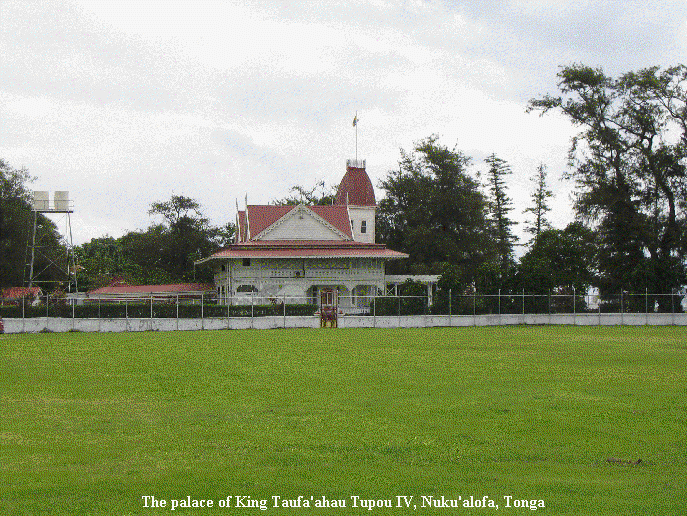 A strike by public employees in the tiny South Pacific island of Tonga, a feudal kingdom in a post-modern world, is now in its sixth week. If anything demonstrates with utter clarity the profound reach and pace and intent of corporate globalization, it is to be found in off-the-track places like this, barely noticed in North America, but where astonishingly familiar stories unfold.
 The immediate issue is a new public service salary scheme which has granted huge increases to senior officials in the kingdom, even by Canadian standards (the equivalent of $60K), while ordinary public employees are so poorly paid that some can't even afford to buy shoes. 400 or so of the country's 4500 public employees were offered no increase at all. Indeed, public service employees have had no raise for nearly twenty years, during which time high inflation has raged. The Public Service Association (PSA) leading the strike is demanding increases for its members of 60-80%, meaning, in reality, that some of its members earning annual salaries in the order of $1,100 might be able to provide a tiny bit better for their families. The government has countered with an offer of 30%.
The strike has gained considerable public sympathy. Dr. Ana Akavola, for example, who runs the radiology department at Vaiola Hospital, got a 28% increase, but she walked out after seeing people in her department get increases no higher than 8%, with some getting nothing. Students rioted when their college principal was fired for supporting the strike. Religious leaders are climbing on board: Reverend Simote Vea, general secretary of the Tonga Council of Churches, says that ministers "are more openly talking about political issues than before. It used to be a kind of taboo." The Queen herself was recently subject to a mild rebuke from the pulpit in her own church.
A support march in Nuku'alofa, the capital of Tonga located on the island of Tongatapu, attracted 10,000 anti-government demonstrators, a huge number considering that only 67,000 people live on the island. The expatriate community has rallied round the strikers, with a large group in Auckland conducting a vigorous demonstration outside a luxury home belonging to the King. (The royal family owns $8.2 worth of property in Auckland. Just turned 87, the King is presently in Auckland getting medical treatment.) New Zealand, Fijjian and Australian unions have pitched in with aid as well.
The PSA has flatly rejected resolution efforts by a seasoned New Zealand labour mediator, former Employee Court Chief Judge Thomas Goddard, who has since returned home. Besides a series of demands ranging from pay increases to a return to the old salary structure, the PSA is now demanding political reform:it wants the King-appointed cabinet to be elected. Otherwise, said strike committee chair Finau Tutone, there can be no guarantee that an agreement with his union would be adhered to. Pesi Fonua, the editor of the Matangi Tonga on-line news outlet, observes that the current strike is now effectively calling for "regime change."
The strike is unprecedented in Tonga. This is a country where the royal family and hereditary nobility (like "Tonga" itself, largely a construction of Wesleyan missionaries in the early 19th century) are firmly, if not absolutely, in charge. They own most of the land, and the royals have vast business holdings as well. The King, Taufa'ahau Tupou IV, and his immediate family, are rolling in vast wealth. Privatization meant handing the state electricity company over to the personal ownership of the Crown Prince, Tupouto'a Tuku'aho, while the King’s daughter, Princess Salote Mafile'o Pilolevu Tuku'aho, made a huge personal fortune grabbing up geosynchronous satellite slots connecting Asia with the US West Coast.
The King is noted for spending fortunes in public revenue on frankly squirrelly schemes such as a process to turn seawater into fuel, and another to burn used tires for profit (Greenpeace put a stop to that one). He once proposed leasing the population's DNA to an Australian genetics firm, and he started a program of selling passports at high prices to Asians. The latter actually turned a tidy profit of $30 million, but that completely disappeared, having been left in the hands of an American magnet salesman who earlier on had petitioned successfully to be appointed as the King's Court Jester. I didn't make this up. The locals have a name for that sort of thing: fakatonga, the "Tongan Way."
It should come as no surprise that the demands of the strikers are beginning to include fundamental democratic reforms. The current Parliament (Fale Alea) consists of thirty seats: twelve Cabinet members appointed by the King, nine seats allocated to the nobility, and nine provided for the commoners. Recently the Cabinet was expanded to include two noble MPs and two commoner MPs. But the people are restless: a pro-democracy movement has been gently agitating for more than a decade. In terms of reform, it has been fairly cautious. In 2002, for example, the Tonga Human Rights and Democracy Movement demanded a restructuring of government, with an elected lower house of twenty-one members, and an upper house of nine nobles (the approval of both Houses would have been required to approve legislation), with the King still free to appoint the Prime Minister and the cabinet.
The King is no fan of strong criticism, and he got the constitution changed in October 2003 to permit the banning of newspapers. That galvanized thousands of Tongans to demonstrate in Nuku’alofa in the largest public protests ever seen up to that time. The King was particularly galled by the cheeky Taimi o Tonga, published in New Zealand, which he had failed in earlier attempts to keep out of the country. What appears to be a genuinely independent judiciary would simply not back his efforts. And this continued: the Supreme Court ruled last October, with due apologies to His Majesty, his cabinet and Parliament, that the constitutional change was in conflict with other parts of the constitution, and once more the ban was thrown out.
The attempt to muzzle press criticism was not a move favoured by all of the royals. The Crown Prince was cautiously opposed; a royal nephew, before the constitutional change took place, said that such a move would turn Tonga into a "police state." The Minister of Police at the time, however, one Clive Edwards (his father was British, hence his distinctively unPolynesian name), publicly supported the ban and the constitutional amendment, claimed that pro-democracy forces numbered only about fifty vocal people, and proclaimed that democracy, in any case, was "too expensive" for Tonga.
But perhaps he was just doing his job at the time. Edwards was later sacked from Cabinet, and re-emerged this past May as a born-again democrat, running for a commoner's seat in Parliament in a by-election and winning. He’s now front and centre in the protest, urging the strikers to take anti-scab measures and demanding democratic reform. (For his part, the Prime Minister, Prince 'Ulukalala Lavaka Ata, found it "unusual" for a former Minister of Police to be doing this, and accused Edwards of incitement to riot.)
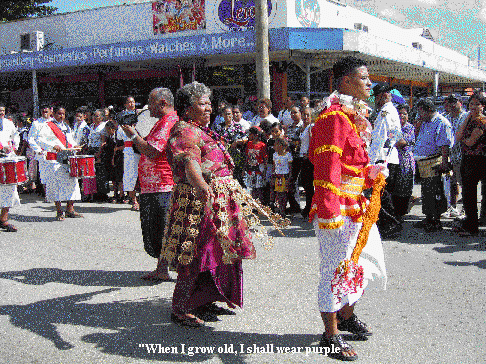
There are no political prisoners in Tonga, no secret police, no torture: that's not the way Polynesians do things. There are many things I like about the place, actually. This is a country that expropriated a golf course to make way for a sacred burial ground, a kind of Oka in reverse. One Catholic church has a thriving fish and chips restaurant in the basement. Homosexuality is not illegal, despite the power of the churches, and transgendered people are, as in Samoa, an important component of the social fabric. The capital city, Nuku'alofa, boasts Internet cafes and pretty decent cappuccino, a good beer called Ikale (Eagle), the brewery part-owned, unsurprisingly, by the royal family, and the people do know how to celebrate. Huge crowds came out for the opening of Parliament in 2003 when I was there, and the mood was not that of a people living in fear.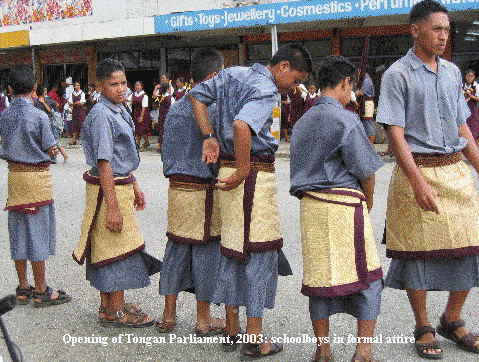 But the differences between rich and poor, between nobles and commoners, are enormous. Shanty-dwellers on the outskirts of Nuku'alofa have been ordered by the King to move, but they have no place to go. Unemployment is high, and people are leaving the island at the rate of 2,500 a year, which has a not-insignificant effect on the local economy. Indeed, almost as many Tongans now live offshore as in Tonga, and their remittances, making up most of the country's income, are essential in keeping the place afloat.
The impetus for the current popular reform demands arose from structural adjustments begun in 2002. The government undertook a modernization of the public service, something that should have a familiar ring for Canadian federal public employees. Restructuring began at the top: senior officials were rewarded with salaries even higher than those of cabinet ministers. Privatization has been good to the Crown Prince, as noted, giving him a formerly state-run electric power company; in addition, he runs a telecommunications company that competes with the publicly-owned Tonga Telecommunications Corporation.
Earlier this year, thousands of people took to the streets in a protest against increases in electricity rates, demanding that the Crown Prince-owned electricity monopoly, Shoreline, be returned to the state. It was a not-so-thinly disguised pro-democracy march, shadowing forth the current upheaval.
If you think you might have detected a sour whiff of the IMF in all of this "restructuring," you'd be correct. Earlier last year, in July, the IMF Executive Directors held a "consultation" with Tonga, expressing "concern" at the slow pace of "structural reforms." In their own words:
Directors considered that concerted efforts to limit the wage bill--which remains high by regional standards--and to contain transfers to public enterprises and the rest of the economy will be key elements in consolidating the fiscal deficit. In this regard, Directors expressed concern about the direction of the public service reforms underway, which could undermine much needed wage restraint and impede a genuine restructuring of the civil service. They reiterated the importance of public enterprise reform to improve the efficiency of these enterprises and significantly reduce any transfers to them.
…
Directors agreed that improvements in the country's medium-term growth prospects will require the authorities to expedite the implementation of structural reforms in the public sector and take steps to promote private sector development.
It is not clear precisely what the nature of the concerns about "direction" are, but Tongan officials jumped to. "Structural adjustment" is a priority, said the Governor of the Bank of Tonga, Siosiua T.T. 'Utoikamanu, at the IMF's annual meeting in Washington, D.C. a few months later. In a prepared statement, he noted that "the two Bretton Woods institutions [the IMF and the World Bank] continue to be valued partners," and assured them that the Tongan government is continuing to take the necessary steps to "pursue its reform objectives," including "structural changes to the public service to achieve higher levels of efficiency."
The Asian Development Bank is also involved:
In 2003, the Government focused on implementing the Economic Public Sector Reform Program (EPSRP), which has the primary aims of maintaining a stable macroeconomic environment and achieving sustainable economic growth led by private sector development.
…
The EPSRP, recognizing the likely uneven impact of any rightsizing actions on women and youth, has established a unit in the Prime Minister’s department to monitor such impact, and has earmarked funding for mitigation measures.
The editor of Matangi Tonga, Pesi Fonua, notes that the structural reform initiative was supposed to ensure that jobs would be created to absorb public employees displaced when the public service was eventually downsized. There is no doubt, of course, that public service reform in Tonga is necessary: it's part, after all, of a creaky governance structure that people are now in the streets demonstrating against.
But privatization has not improved the lot of ordinary Tongans. Things just haven't gone according to plan, as the earlier demonstrations against electricity increases indicated: privatization has meant high executive salaries, the waiving of electricity bills for cronies, and a rate increase for everybody else. Free trade, Fonua points out, is presently "more of a threat…than an advantage," and an Open Skies policy hasn't made any difference whatsoever in international air travel to Tonga.
In fact, if there was ever living proof that the "one size fits all" privatization nostrum prescribed by the IMF is unworkable and destructive, lass' Sie nach Tonga kommen, to paraphrase JFK. The IMF demands have, in classic dialectical fashion, unleashed forces in Tonga that seem poised to make fundamental positive changes. Imposing a cold, ideologically-bound economic formula on Tonga has succeeded in causing enormous dislocations--but it has also brought the people together with an increasing confidence in their collective strength.
The status quo is clearly untenable, as frail as the King himself. There are just too many modern ideas flowing into the Kingdom of Tonga, too many stresses and strains between old and new. But the privatization reforms imposed by the IMF are yielding a double effect, no doubt doubly unwelcome to the powers that be: they are putting an exploitative hierarchical system in serious jeopardy, and they are increasing the resolve of ordinary Tongans to reach for something better than the further enrichment of the already rich through "structural reform". It's a perilous journey, and I wish them well.
Sunday, August 28, 2005
Ecuador gets a friend in need
An interesting story has been developing in the tiny nation of Ecuador for several days. Protesters have managed virtually to shut down the national oil industry, whose exports account for a quarter of the country's GDP, with a fierce campaign of demonstrations, occupations and sabotage. The country was in danger of defaulting on its export commitments. But Venezuela’s Hugo Chavez came to the rescue late this past week, and is sending a "loan" (actually a gift) of Venezuelan oil to cover off those exports. That was where I got interested.
I felt a certain sense of betrayal at first. Chavez is my kind of leader. He's a genuinely popular man of the people, who stands up to the US not just in word but in deed. He has, to Washington's foot-stamping annoyance, won a free election in 1998 with ease, handily survived an incompetent two-day Keystone Koup and an internationally-supervised recall vote, and, now more popular than ever, he's liable to see his support spike still higher in the wake of Pat Robertson’s recent call for his assassination.
Far from being a "strong-arm dictator," (Robertson's words), Chavez respected the astonishing ruling of his country's top court, which found the coup plotters not guilty of anything. They walk free today. Imagine that happening in Canada, or the US.
The wealthy elites and the Bush administration hate him with a passion, and their sludgy stream of lies finds ready acceptance in the mainstream media. In fact, the administration is so fanatical on the subject that they have even been asked to tone it down by staunch Republican Arlen Spector.
Chavez is busy these days: as reported by a right-wing Venezuelan, spluttering with indignation, he
• Has bought half a billion dollars of Argentinean debt;
• Is bailing out the Uruguayan National Airline, cost unknown;
• Is injecting $50 million into PetroCaribe, a regional organization to provide the Caribbean countries with subsidized oil;
• Has donated $50 million to the Andean Community for unspecified social programs;
• Is promoting the creation of PetroSur, an oil organization similar to PetroCaribe for the Southern Cone;
• Has increased the supply of strongly subsidized oil to Cuba from 53,000 barrels per day to 90,000 barrels per day;
• Has sunk $10 million into a Venezuelan-controlled regional TV channel, Telesur;
• Is planning to buy 42 oil tankers from Brazil for some $2 billion;
• Has bought about $2 billion worth of helicopters, tanks, guns and other assorted weapons from Russia.
He's also teamed up with Fidel Castro to send doctors to impoverished parts of Latin America. More than 60% of Venezuelans now have free medical assistance. Food for poor families and prescription drugs are subsidized. Chavez has built housing, schools and clinics, increased literacy through more education spending, and abolished fees for public school attendance. Venezuela has one of the lowest infant mortality rates in Latin America. The vast majority of his people love him to bits.
So what's Hugo Chavez doing supporting a pro-American, free-market President, and undercutting popular protests?
First impressions, as it turns out, can be completely off the mark, and this proved to be one of those occasions where a little digging reveals a different story. Here's some background.
Ecuador is the fifth-largest oil producer in Latin America. Most of its exports go to the US. In the past, huge multinationals like Texaco and Occidental have invested heavily in Ecuador and made a lot of money, but the going hasn't been easy for them. Texaco, as noted below, is currently embroiled in a huge lawsuit brought by indigenous peoples in Ecuador. Occidental is being sued by the government for breach of contract.
Ecuador is a desperately poor country, despite its estimated 4.4 billion barrels of oil reserves. Oligarchs who once ruled Ecuador stripped it of its assets, and now sit in Miami as bondholders for this heavily-mortgaged nation. The country’s former president, Lucio Gutierrez, had to kowtow to the IMF and the World Bank just to get loans to survive.
Presidents of Ecuador have been between the proverbial rock and a hard place for some time. Popular unrest led to the deposing of Jamil Mahuad in January 2000, with Vice-President (and banana billionaire) Gustavo Noboa assuming power and presiding over the dollarization of the economy. Lucio Gutierrez, a left populist, governed from January 2003 until this past Spring, when he was driven from office.
Guttierez' story is in some respects remarkably similar to that of Hugo Chavez. He had risen to prominence when ordered by President Mahuad to break up indigenous peoples' demonstrations in Quito in 2000: instead, he set up soup kitchens for them. He engaged with others in an attempted coup, spent time in jail, and then ran for office against Noboa and won.
But he was deposed this past April when his compliance with "structural reform" had become too much for his people to bear, and his attempt to replace the Supreme Court had offended the Ecuadorian Congress. A well-circulated picture of him shaking hands with George W. Bush, and his increase in the price of cooking fuel and other supposedly voluntary "austerity measures," helped to send "Sucio Lucio" (Dirty Lucio) running to the Brazilian Embassy to seek political asylum.
The "voluntary measures," it turns out, were nothing of the kind. The Nation obtained a copy of the World Bank's 2003 Structural Adjustment Program Loan. It dictates that 70% of the windfall increase in oil revenues in the past few years be paid immediately to the bondholders, and another 20% be set aside for future payments. Only 10% was permitted to be used for social spending, in a country of grinding poverty where only a lucky few make the official minimum wage of $153US a month. Electricity prices were to rise to twice what the average American pays, to enrich Ecuadorian electricity suppliers such as American companies Noble Energy and Duke Power.
The new President of Ecuador, Alfredo Palacio, was Gutierrez' Vice-President. He happens to be a conservative, pro-market, pro-American former cardiologist, but the US is already unhappy with him, which is probably good news for poor Ecuadorians.
Says The Nation's Greg Palast:
I showed President Palacio the World Bank documents. He knew their terms well. "If we pay that amount of debt," he told me, "we're dead. We have to survive." Given the oil windfall, Palacio sees no need to follow Gutierrez's path to economic asphyxiation. "It is impossible that they condemn us not to have health, not to have education," he told me. He made it clear that handing over 90 percent of his nation's new oil wealth would not stand.
...
Palacio got the full "Chávez" treatment from the New York Times, which ran the headline "Ecuador's New Chief Picks Cabinet; Leftist in Economic Post" after Palacio's new finance minister announced Ecuador would put social-services programs first ahead of payments to bondholders. The Times said Palacio's views "ruffled some feathers" (whose, we don't know) and that foreign powers questioned the "legitimacy" of his right to office. Palacio smiled, "They don't say which ones."
Palacio might be a conservative, but he’s a doctor, and he's a realist: "Sick people are not going to produce anything," he said.
So who are the protesters at his door? The Financial Times calls them "community groups." Their leaders include mayors and regional governors from Orellana and Sucumbios provinces, in the Amazon region where much of the oil comes from. They want roads and jobs and more money spent on health, and they're demanding that the oil companies "reverse the environmental damage they have done," as one mayor in Sucumbios, Edmundo Espindola, put it.
Indeed, Sucumbios and Orellana provinces, with large indigenous populations, have suffered pollution ravages at the hands of Texaco on a catastrophic scale. This past May, after a US court ruled that a lawsuit launched in 1993 should be decided in Ecuador, a new suit was brought in that country. 30,000 indigenous people and campesinos affected by oil exploration and extraction are represented. In the current protests, then, we can see environmental, regional and indigenous factors at play, as well as the traditional demands of the poor. It's an explosive mix.
There's a shaky truce in effect at the moment: oil companies and the government promised road building and health spending, although it took only a couple of days for the deal to begin to unravel: protest leaders have angrily denounced apparent backpedaling. 16% of the income taxes paid by the companies were to be diverted towards health, environment and local development, but this, according to Espindola, has become "up to" 16%. Road construction, originally to be completed in three years, will now be done "when possible." The next few days should be interesting ones.
In the meantime, Palacio knows there have been seven Presidents of Ecuador in the past nine years. He faces a rebellious population on one hand, and George Bush, rich expatriate Ecuadorians, oil companies and the IMF/World Bank on the other. He has a hard row to hoe, as did his unfortunate predecessor. But he's found a wealthy supporter in Hugo Chavez, and the balance may have tipped in Ecuador's favour. As a former minister in his government, Rafael Correa, put it, "this time we will not negotiate with Wall Street but with friendly countries." How nice to have a choice.
Saturday, August 27, 2005
Day-boy at Hogwarts
[Reference: "Help! Mom! There are politics in my children's books!"]
Taking the magic train twice a day is no picnic, and I never did get to meet Harry, so don't ask. I'm the kid in the second row, rooting for the Hufflepuff Quiddich team, for all the good it did: they never had a prayer, so the Pope says. The Slytherin folks magicked their way into the championships as usual, and won the last two with fixed brooms and obedient Golden Snitches. They're busy raiding another school or two at the moment, setting up new classes in adder-baiting and spell-binding. Their leader, Draco Malfoy, keeps waving his huge wand around. He could put out someone's eye with that thing. Good imported witch-hazel, every twig ensorcelled by a nasty charm called the countervail that gives even more gold to his rich friends.
Today is a typical day. (We don’t get any days off, by the way, because that could interfere with what muggles call "the learning process.") I hate Snape's class. He's always got us up to no good. Old Dumbledore just looks at us sadly when we show off our new powers. "Develop your own," he moans, and talks a lot about "cultural identity," whatever that is. All I know is the spells Snape taught me work even better since Draco’s friend Crabbe was given a special term assignment called the "CBC." They say he's going to fail, though, because he didn't hand it in. He says he lost it, but we think he buried it somewhere. And you know what? I bet he's going to get an A+ anyway.
Snape had a kid named Arar kicked out of Hufflepuff over to Slytherin, and another kid named Almalki who was visiting the place, just because he didn’t like their names. Said we might learn something, but they just got bullied for a few terms and we didn't learn anything at all. At least, I don't think so, but Snape keeps looking mysterious and invoking the National Security Spell of Silence.
A handful of Slytherin kids were living in nearly half of Ravenclaw, sort of grabbed it some time ago. A friend of Malfoy's, Gregory Goyle, got them moved out so the Ravenclaw kids could move back, but now they're over here in Hufflepuff, joining a bigger bunch who've been taking over our place for years, wing by wing . One thing even a day-boy notices: the drinking fountains only work in the Slytherin-occupied parts of the building. But everybody thinks Malfoy's friend did something good. I think somebody's slipped them one of Snape's potions.
Like I say, it's a pretty ordinary day. There's another Worm in the walls, called Zotob. Some of the Slytherin second-years are beating up on a new bug named Cindy from Gryffindor because they say she talks too much. A kid was caught down in Hogsmeade smoking magic weed. They're going to expel him to the Dark Lands, I hear. A greedy bunch in the Great Hall won't share their oil, as usual. Hermione's pet moonbat escaped, but she's not getting any help because nobody else here seems to like the things. McGonagall is teaching us all how to voip. And Dumbledore is telling everybody to watch out for Lord Voldemort.
What I can never figure out for sure is just who Lord Voldemort is. Everybody talks about him all the time: Hogwarts is always being threatened. I know that because Dumbledore flies different coloured flags every day to let us know when we're in danger, at risk, or just unsafe. Some call Voldemort a Mullah, or a Sheik, or even a Caliph named "Osama." But others say he's Draco Malfoy's father, Lucius. A few creepy-looking kids are whispering that Draco's friend Goyle is behind it all. Some think Lord V. is Draco himself.
There's still so much to learn. But I gotta go. No way I want to be in this place after dark.
Friday, August 26, 2005
Liberty and Safety
On the Globe & Mail's masthead appears this quotation from Junius: "The subject who is truly loyal to the Chief Magistrate will neither advise nor submit to arbitrary measures." The newspaper's shameful defence of security certificates today departs from its own advice at near-lightspeed.
Adil Charkaoui had been imprisoned without charge or trial under a security certificate for nearly two years, until he was finally freed on bail on February 17. Four other detainees remain behind bars: Hassan Almrei, for close to four years; Mohammad Mahjoub, for more than five years; Mohamed Harkat, for nearly three years; and Mahmoud Jaballah, for four years this month. All face torture, and possibly execution, if deported to their countries of origin.
Charkaoui has been granted a review of his detention by the Supreme Court of Canada. This has prompted the Globe to publish possibly one of the most dishonest and disingenuous editorials in its recent history, although there are many to choose from. It’s worth dissecting in detail.
Here is its major premise: "Far from being a Draconian attack on non-citizens, the security-certificate law makes possible the country's generosity and openness." It goes on: "A country cannot embrace all the world's peoples, as Canada does, without reserving for itself the right to remove those newcomers it deems dangerous -- as long as due process is preserved."
Now, let's have a look at that "due process" the Globe is prating about. Charges under Canadian law? Nope. A trial? Nope. The right to examine evidence? Nope. The right to cross-examine witnesses? Nope again.
What these five men get is a deportation hearing. As the Globe says, the government has the right to detain and then deport them "if it persuades a judge that its belief is based upon reasonable grounds." In fact, the editorial lays out precisely what "due process" amounts to in these circumstances:
The government may ask a Federal Court judge to keep some of the evidence private, either to preserve national security or to protect the safety of individuals. But it is the judge, not the state, who decides what is private and what should be public….A hearing follows in open court, and the suspect and his lawyer are given a chance to call witnesses, and to rebut the state’s case. The secret parts are summarized by the judge. There is a frequent opportunity for review by independent judges.
Why am I not reassured? Because I try to put myself in the place of Adil Charkaoui. I have a lawyer, who doesn't know the charges against me, because there aren't any, nor can she review much of the evidence. She tries to cross-examine a CSIS witness: the witness declines to answer, on the grounds of "national security." The judge (a government appointee) summarizes evidence, but is obviously not subject to cross-examination. Numerous ex parte meetings take place between the judge and the government lawyers. I begin to wonder if I'm really in Canada after all. Then it's back to prison, unless I'm lucky enough, on my fourth attempt in 21 months (like Adil Charkaoui), to make bail, under such strict conditions that I need to go back to court to ask permission to find books in a library.
"The law is respectful of due process," the Globe editorial continues. I begin to wonder why it wasn’t written in Newspeak: Big Brother is doubleplusgood. Here's more:
Once here, anyone, whatever crimes they may be suspected of [emphasis mine], is entitled to make a refugee claim. …The protection of Canada’s Charter ensures an impartial hearing for refugee claimants. That process may take years. Consider, then, what might happen if there were no security-certificate law, and a suspected [emphasis mine] crime boss or terrorist entered Canada. He might live for years in freedom.
Horrors! Innocent until proven guilty! But how to prove guilt?
Should Canada send police abroad to conduct a criminal investigation every time someone who raises a red flag comes to this country? That is not a realistic option, or even a desirable one.
The question of precisely how that "red flag" gets raised, of course, is left out of the editorial. The system worked well for Maher Arar, didn’t it? And he was a citizen!
Then this piece of disingenuous claptrap:
Imagine…that a terrorist incident occurred, as it did in Britain last month with the loss of scores of lives. Canadians would discover that they were powerless to do anything about foreign terrorist suspects living in their midst.
The fact that the bombers were home-grown has escaped the writer. But, more seriously, the editorial plays a sleazy little game with language: are the "terrorist suspects" in the above example implicated in the "terrorist incident?" If so, Canada is anything but powerless: our police could round them up and charge them, our courts could try them, and, if found guilty, could imprison or deport them. That's due process, folks. No closed courts. No secret evidence. No years in prison without charge or trial.
The Globe concludes:
Mr. Charkaoui is asking the Supreme Court, in effect, to choose liberty over security. The choice is a false one. One is not possible without the other.
No, he is not, so let’s dispose of that straw-man. Mr. Charkaoui is challenging the grounds for his imprisonment without trial, and his threatened deportation to Morocco, where he faces the likelihood of torture and death. (Canada’s non-compliance with the UN Convention Against Torture, in fact, has recently drawn critical scrutiny from the UN’s Committee Against Torture.) He is asking for the very due process, in fact, that has been denied to him thus far.
Perhaps the editorialist, who reassures us that the police and the courts and the government must know what they’re doing, would walk us through the Maher Arar mess, just to show us that we have nothing to fear. Or explain why the Globe, presumably not privy to the secret evidence on that occasion either, so hotly attacked the use of a security certificate in the case of neo-Nazi Ernst Zündel.
"Those who would give up Essential Liberty to purchase a little Temporary Safety," Benjamin Franklin is alleged to have said, "deserve neither Liberty nor Safety." Ben, meet Junius. And why don't the two of you have a nice sit-down with the Globe editorial board?
Thursday, August 25, 2005
Seven
Having spent far too much time reading fundamentalist right-wing blogs recently, I thought I might take a stab at looking at the world through a Christian lens today. Exercising the imagination is useful on occasion. Oddly enough, though, things look much the same as they always have, ranging from the bizarre to the extreme. The categories are fun to work with, however, so here are some updates on the Seven Deadly Sins. (If I get around to it, I'll post something on the Seven Heavenly Virtues sometime, but I find sin far more interesting. Don't you? Hands up all those who prefer Dante's Paradiso to his Inferno. Yeah, thought so.)
Pride: City employees in Buffalo enjoy good medical benefits, including elective cosmetic surgery. Police and firefighters head the list of those who are seeking corporeal retrofitting. Middle-aged Detective James Giardina opted for a $4000 hair transplant, while balding Officer Kevin Biggs went the other way: "It was more convenient to have the neck hair removed than to shave it on a daily basis," he said.
Not realizing the peril to his immortal soul, Detective Giardina said, "I'm not a real vain person, but I guess I do feel better."
Buffalo civic employees had 2,451 cosmetic procedures done last year, including 363 liposuctions, 181 face-lifts, 152 breast enlargements and 126 hair transplants.
Envy: This sin is defined as "the desire for others' traits, status, abilities, or situation." A man in the US named Dennis Avner has had countless surgical procedures to make himself look like a tiger: his teeth have been replaced with "tiger-like" dentures, his upper lip has been split, his ears are now pointed, and eighteen piercings above his lip permit the attachment of whiskers.
Or is this pride? Why not, er, ask him yourself? I'm a dog person.
Greed: Closer to home, comfy Ontario is crying poor. Having to help out less fortunate provinces under the federal equalization scheme may reduce the province to "have-not" status within five years, according to the Ontario Chamber of Commerce. This brings to mind a comment attributed to John Kenneth Galbraith about neo-con economics: it's based on the notion, he said, that the poor have too much money and the rich don't have enough.
Meanwhile, in Vancouver, workers are fighting among themselves: a recent $14.5 million 6/49 jackpot was claimed by nine employees from an A&W, but the payment has been put on hold until the claim of two additional workers to have been part of the pool is investigated. If upheld, each employee will still receive around $1.3 million. Minus massive legal fees, of course. Four rootbeers for the lawyers at Table Three, please.
Gluttony: Investigators have discovered that the ingestion of sugar triggers the release of opiate-like compounds into the body in what has been described as something similar to addiction, or the switching on of an in-built craving. A professor of psychology and neuroscience at the University of Wisconsin, Ann Kelley, notes: "This is a very ancient motivation. Even bacteria will swim toward sugar."
This raises a delicate theological point. To what extent are we prisoners of our physiology? Do we have choice in the matter? Is there a gay gene? [Cancel that last one--ed.]
Or could this be, on the other hand, an argument against “intelligent design?” Not necessarily: perhaps, as one commentator put it, God should simply never have taken that day off. Maybe then our sinuses wouldn’t drain upwards, either, and males would have a safer place to store a couple of their reproductive organs.
Lust: The Mexican National Women's Institute is up in arms over a campaign by conservationists to save the turtle. Men have apparently been scarfing down turtle's eggs to reach the finish line--they're said to be a kind of natural Viagra. Wildcoast, a conservation group, has been employing Dorismar, a scantily-clad Argentinian model [You’re welcome--ed.] in public service announcements. "My man does not need turtle eggs because he knows they don’t make him more potent," she says, in various skimpy costumes.

The women's group, not unreasonably, sees this as a step backwards in their continuing struggle to overcome deeply-ingrained Mexican machismo. The Wildcoast folks aren't backing down, though: they maintain that they're trying to reach the very audience that needs reaching. The total numbers of seven species of sea turtles had dwindled to a few thousand by last year, thanks to widespread egg-poaching [No more of that--ed.]. Another chapter, it seems, in that on-going Velikovskian political epic, When Struggles Collide.
Sloth: Corinne Maier, an economist at Electricité de France (EDF), a state-owned utility, has written a best-selling book, Bonjour paresse (Hello, Laziness). She is a strong believer in the siesta ethic. In her words:
Businesses don't wish you well and don't respect the values they champion. This book will help you take advantage of your company, rather than the other way around. It will explain why it's in your interest to work as little as possible and how to screw the system from within without anyone noticing.
Anger: EDF started disciplinary action against Maier for "spreading gangrene through the system," and (strangely) for not acknowledging on her book’s back cover that she worked for them. They quietly dropped it after the book became a best-seller. Asked why she remains at her job, she said, "I stay only because it makes my boss very angry."
Only The Da Vinci Code outsold the book in France last year. That could tempt quite a few Christians to be angry, too.
Subscribe to:
Posts (Atom)