Tuesday, January 30, 2007

When in Hérouxville...

Ayoye!

The town fathers of Hérouxville, Québec, have issued a fatw...er, un avis public, to prospective immigrants, following a perfectly gender-balanced survey of residents that garnered 98 female and 98 male respondents. It's obviously a tolerant and progressive little place, where only two of the respondents defined themselves as "racist" (two others weren't sure), and only four wanted to take away women's right to vote. A larger number (10) did not know that the Québécois were une nation, so Stephen Harper has a little work to do in that respect; but only three were opposed to female police officers arresting male suspects.

This consultation having satisfied the requirements of a democratic town council, the Mayor, one Martin Périgny, fired off letters to the Minister of Foreign Affairs, Peter MacKay, to the Secretary of State, Helena Guergis, and to the Immigration Minister, Diane Finley, not to mention a gaggle of Quebec Cabinet ministers as well. His purpose was to announce, based upon his sondage, the town norms, here Babelfished into English for your delectation. Immigrants, he said, would be expected to conform to them. No stoning of women. No clitoredectomies. Mixed swimming pools. The whole nine yards, as they say in Baghdad.

Now, one can understand how those who feel that their culture is under siege can become self-conscious about it, and reify it into texts and images. One thinks of the Maori haka performed in front of legions of pakeha, having lost much of its original significance but having gained a different significance, or the Inuit values of survival now codified as Inuit Qaujimajatuqangit. Those artefacts, changing their meaning with the times, are created to prevent erasure. But the good burghers of Hérouxville are not the bearers of a threatened culture at all. They represent the dominant culture, in fact, and are engaging in a bit of good old-fashioned triumphalism.

One can see abundant evidence of this in the norms that they are now promulgating, and in the way in which those norms are expressed. As noted in the Montreal Gazette, it's rather like those resolutions passed by little Ontario towns a while back declaring that they were officially English-only--Sault Ste. Marie, for example, St. Mary's Falls, that is (with "Ojibwa Kitche Gumeeng Odena" on the town crest, just to make things really interesting).

The norms are explicitly confrontational, for one thing, the town council wagging a collective finger at people unlikely ever to settle there, caricaturing other cultures, demolishing stereotypical strawmen, gratuitously forbidding behaviour unlikely ever to occur. Those who applaud, like Brigitte Pellerin, ("A small town defends its local customs") or the egregiously stupid writer of the hed in the National Post ("Herouxville wants immigrants that fit in with its citizens") are missing something fundamental: this is not a defence of local culture at all, which is not remotely under threat. It's a cartoonish attack on others. And such attacks resonate, unfortunately, with the ranks of les Québécois pure laine--not that other parts of Canada are by any means immune from that sort of nonsense.


Meanwhile, in another part of the forest, a police officer from Montreal is in a bit of trouble over a cheerfully xenophobic song making its way around the Internet, Ça commence à faire là.

"Si tu n'es pas content de ton sort, il existe un endroit qui est l'aéroport" he sings, to a fairly catchy beat. It turns out that he was particularly exercised by a recent incident where Hasidic Jews demanded that a YWCA frost its windows so as not to tempt young Hasids at an Orthodox synagogue across the street who might chance to see spandex-clad women working out on the premises. And an internal police magazine suggested at about the same time, pouring oil on the flames, that female officers step aside to allow their male colleagues to deal with Hasidic men--getting the police union all upset and causing some puzzlement in the Hasidic community, which had never suggested such a thing.

Of course, the Hasids have been established in Montreal for generations, so that telling them to head to the airport has no doubt earned the tuneful flic a few puzzled looks. But other accomodements have also caused offence recently: men being banned from pre-natal classes because Muslim women were present, for example. A Sikh schoolkid carrying a tiny knife sewn into his clothing. A Filipino child eating with a spoon. If that keeps up, Québec will be just a province comme les autres before you know it. It's a slippery slope, câlisse.

Anyway, his song was soon all the rage, and his bosses found out. "Le policier dans l'eau chaude," says the headline.
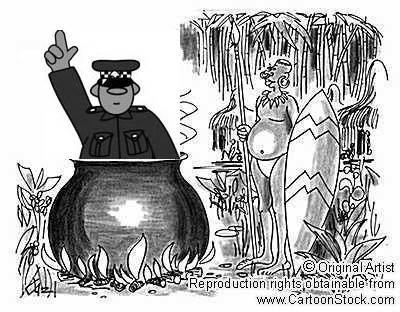

Not in Hérouxville, mon chum.

UPDATE: (February 2) A parody has appeared. Some knowledge of la parlure required.
(h/t Marc-Alain Mercier).

UPDATE: (February 10) The Globe & Mail has an excellent editorial on the subject today. "This statement [the avis public] only purports to be about shared values. It is an insult and a provocation...."

Sunday, January 21, 2007

Barracking Obama

The knives are out for Democratic presidential hopeful Barack Obama--not because of his wishy-washy, centrist politics, but because...well, he's a closet Muslim, sources close to Hillary Clinton are muttering. (h/t Cynapse)

Or maybe he's just an uppity Black man who doesn't know his place. The discussion has certainly become heavily racialized on the Right. As one Canadian conservative commentator puts it, "
Black, stupid or both: that's your only excuse for getting excited about Barack Obama." She continues, referring to Obama's mixed-race background, [T]here is nothing 'compelling' about a black man impregnating a white woman. In more than one Toronto neighbourhood, that's what they call 'Saturday night.'"

So a big hat tip today, to Candace of Waking Up on Planet X. She really says all that needs to be said.

UPDATE: (January 21) Did she or didn't she? There has been considerable debate, here, at Candace's place and elsewhere, as to whether the Hillary Dems were behind the "closet Muslim" smear. The story
referenced above did appear in a right-wing magazine, using unnamed "sources within the Democratic party." Could the Repubs have indeed managed a "two-fer," slinging the mudpies at Obama and putting the blame on Clinton?

But if that were the case, why would Repub strategists do this before the Democratic nomination was secure? In answer to the following question in an ABC/Washington Times poll:
"37. Do you have a favorable or unfavorable impression of (NAME)? Do you feel that way strongly or somewhat?" Hillary Clinton scored 56% favourable, with 27% "strongly favourable." Obama's numbers were 44% and 21%, trailing Nancy Pelosi and John Edwards. For the opposition, Rudy Giuliani racked up 67% and 49%.

Obama as Democratic presidential nominee
would be a Republican asset. A Black person with a name like his, beloved of northern liberals, would fight a nearly unwinnable battle in the red states. Elementary strategy would dictate, therefore, that the Repubs hold back until Obama wins the nomination, and then swiftboat him to oblivion. Again, therefore: why now?

So I'm agnostic on the question. I was in error, though, in uncritically attributing the smear to the Clinton camp without noting the provenance of the report. Mea culpa.

UPPERDATE: (January 21) Kathy Shaidle has, predictably and no doubt to her delight, provoked tremendous outrage over here on the port side with her brazenly racist comments about Barack Obama and Blacks in general. Some of the responses, however, seem well over the top to me (and no, I shall not link to them). Commentary about her appearance, and whether or not she is getting enough, is OT as far as I am concerned, not to mention sexist. Can't we set our standards a little higher than the other side?

Thursday, January 18, 2007

Is reality real? Really?

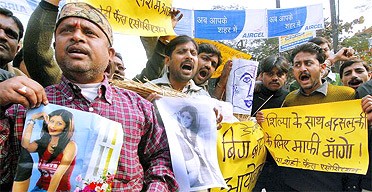
Does the name Shilpa Shetty ring a bell? It should: she's a well-known Bollywood actress presently living in the Celebrity Big Brother house, in the centre of a gathering international storm.

For those not in the know, the Big Brother schtick is to plonk people into a house, make them live together, and, with the assistance of the audience, kick them out one by one. The last remaining tenant wins. Welcome to another iteration of that well-worn oxymoron, "reality TV."

But how much reality is enough? It appears that the delectable Ms. Shetty has encountered not only the usual rudeness to be expected when people are cooped up under real artificial conditions, but some real racism, too. In England! Who'd a thunk it?

As soon as the treatment of Shetty hit the fans, as it were, and she does have her share of them, real trouble erupted in Britain and in India. 18,000 complaints were recorded by the media watchdog Ofcom--the largest number ever received--and 2,000 by Channel 4, which hosts the show. The luckless Gordon Brown, Chancellor of the Exchequer, found himself in India at the time, on an official visit. "I want Britain to be seen as a country of fairness and tolerance. Anything detracting from this I condemn," he said. Tony Blair and London's mayor Ken Livingstone soon followed with condemnations of their own.

During the same time, in Shetty's homeland, there have been demonstrations, effigy burnings and assorted other expressions of indignation. The Indian Finance Minister announced that India-Britain relations would not be harmed by all this, meaning that they have been, at least at the popular level.
"I am confident, he said, "that the universal condemnation of the racist remarks will result in change in behavior of persons associated with the program." Meanwhile, the Celebrity Big Brother audience has swelled from 3.5 million to a staggering 4.5 million viewers. Really.

Of course, this is where it all gets interesting. As we know, well-formulated diplomatic statements are a performance; and so, for that matter, are political demonstrations. We have not moved abruptly from the "real" to the real; rather, what Jean Baudrillard calls simulation has simply been extended. We remain, as the wider audience, squarely within the realm of the hyperreal. Ironically, the only shred of reality that can be glimpsed in all of this* is the blatant racism--and that's precisely what viewers and governments want expunged.

To paraphrase Jack Nicholson: Reality? We can't handle reality. Sure, we want it real. But not really real.
_________________
* This, too, of course, is problematic, given that race and racism are modes of false representation, performed by racists and the racialized alike. But these power dynamics are anterior to the phenomenon of "reality TV."

Tuesday, January 16, 2007

Of Khanny Conservatives, blogroll slander, multiculturalism, Nunavut and abortion nuances

2007 is shaping up to be the usual heap of fragments out of which we construct or shore up our respective ideologies. Is there glitter amidst the dross? Issues that could spark debate but, more important, actually make those of us on the "progressive" side reflect? Well, just maybe.

  • The saga of turncoat/convert Wajid Khan continues to unwind, as it were (h/t Zac). But, bluntly speaking, who gives a rat's ass about Wajid Khan? He's just a venal politician, grabbing the brass ring. He merely highlights the glaringly obvious fact that, if you look at the entire length of the political spectrum--in fact, if you do away with that metaphor altogether and talk instead of political possibilities--there's really not all that much difference between the Liberals and the Conservatives. No, seriously. Who is David Emerson? A former CEO of Canfor Corp. Who is Belinda Stronach? The pampered daughter of a multi-billionaire. Cross the floor one way, cross it the other way...is there really an ideological difference? Only on the surface, if even there.

    Cynical? Not at all. The world is simply bursting with possibilities. But why, then, do we narrow our political focus to include so little? Are wage and price controls Conservative or Liberal? Free trade? Public-sector bashing? Involvement in Afghanistan? Post-9/11 civil liberties? What position on what issue can be said to be fundamentally Liberal or Conservative? Answer: none. What's in a name? It's really one party with two faces.

    There is a fatal fluidity in their respective positions--even with Harper in the driver's seat, a man who actually has an ideology--that's based upon mere tactical considerations, not upon anything remotely connected to principle or vision. Some MPs change parties and make headlines, but many more, with their parties, change their minds
    180° after being elected, and it's business as usual. Or had they all along intended the opposite of what they campaigned for? (Trudeau's wage and price controls leap immediately to mind.) In any case, no issue is safe with either of these corporate entities. Expediency rules.

  • A prominent member of the small-c conservative community has finally spat out her poison: the Blogging Dippers, she avers, are "Canada's leading on-line anti-semitic community."

    Wow. Is Jack Layton's bedtime reading the Protocols of the Learned Elders of Zion? Have Dippers joined the ranks of the Holocaust-deniers?

    Well, uh, no. The International Jewish Conspiracy guys tend to be, er, conservative. Read David Duke's website, if you can stomach it, and see where that crowd stands on affirmative action or immigration. Check out the political positions of leading Holocaust-deniers and fascists like the British National Party's Nick Griffin. The vocabulary is a little more direct--these folks don't hide behind codes so much--but it's all rather familiar, isn't it?

    What Kate means by "anti-semitic," of course, is "critical of Israel." In other words, it's the usual cheap, drive-by smear that the new McCarthyites use routinely to try to silence opposition to Israel's policies. But better they should look within their own ranks if it's genuine anti-Semites they're interested in.

  • According to a recent survey, the Globe & Mail tells us, "[v]isible-minority immigrants are slower to integrate into Canadian society than their white, European counterparts, and feel less Canadian, suggesting multiculturalism doesn't work as well for non-whites."

    Wrong. It's working only too well.

    The premise behind multiculturalism is simply wrong. It's an essentialist premise, based upon the notion that cultures can be caught, packaged and kept pure. Then the people placed lovingly within those boxes are urged to get along with the people in other boxes, and to "integrate" into the bargain. The whole thing is so flawed, so artificial, so contrived, so contradictory, that it is no wonder that the results are precisely what the survey reveals.

    How do progressives who harbour these misgivings find the discursive space to argue them without sounding like conservatives? A good start is to unpack the idea of "integration." One hopes, of course, that people in a community, even an "imagined community," will to some significant degree be integrated--that's rather what "community" means. But integrated doesn't mean homogenized. And it doesn't mean, "you have to learn to be like us." Rather, it means that the unique and shifting perspectives, world-views and narratives of all of those in the community are permitted to combine naturally to make something new. There is no timeless, unchangeable "us," after all.

    We won't get there, though, so long as we maintain our well-intentioned but paternalistic policies of cultural salvage and preservation. We build walls that way, and we're beginning to see the consequences.

  • And speaking of culture, Nunavut has been in the news recently, with a multiple shooting in Cambridge Bay, a community that I have recently visited and hope to visit again. "It's just too late in Nunavut," screams the Globe & Mail headline. "Few take advantage," the sub-hed says, "of available help for chronic alcohol and drug abuse."

    Nothing could sum up the underlying problem of Nunavut better than that. The territory is a magnificent example of the contradictory Canadian policy towards aboriginal populations--supposed autonomy within a context of cheerless, hopeless dependency and continued colonization. Kids go to English-only classes starting from Grade Three. The Nunavut Public Service Act is cobbled together from other jurisdictions, and an Inuktitut/Innuinaqtun translation doesn't even appear to exist. Lip service is paid to traditional cultural values, Inuit Qaujimajatuqangit, but governance is built upon the same model as in the South: hierarchy, power imbalances, fragmentation of the workforce, confrontation. The communities are simply put on welfare, and the symptoms of the resulting disease are then treated--not always very well. Nunavut is presently suffering from all of the consequences of our Canadian version of indirect rule.

    I wish that we could take a look at Kalaallit Nunaat, better known as Greenland, as a case-study of what is possible. Greenland's fifty-six thousand people got home rule back in 1979. More than 80% of the population is Greenlandic Inuit. Greenlandic and Danish are official languages, and the schools operate in Greenlandic. Greenlanders have a university in the capital city, Nuuk. Per capita income is the equivalent of nearly $21K US, and the unemployment rate of 10% is half that of Nunavut.

    Greenland is not economically self-sufficient--half of government revenues consist of grants from the Danish government--but compared to Nunavut (90%), its economy is robust, if heavily dependent, as one might expect, on the fishery and the public sector. Tourism is limited by the climate and season, and current mining possibilities will require some years to materialize. (Source: CIA World Factbook.)

    Suicide among young people is a major problem in both Greenland and Nunavut, although Greenland's statistics are marginally better, as they are for life expectancy. Given the Internet and television, it seems to me that young people in remote areas are presented with excruciating extremes: their probable future toiling in primary industries, or unemployed, and the lavish lifestyle showcased behind glass screens, forever out of their reach. I have often wondered why remote Northern areas do not participate in the "knowledge economy," where one's immediate geography is not a limiting factor. Investment in informatics infrastructure would, at least on the surface, offer tremendous potential and hope.

    While Greenland is not Utopia, then, it still offers a startling contrast to Nunavut. I suspect that its relative success is due to a self-government untrammeled by paternalism and chronic dependency, and to a people whose own values, language and traditions have pride of place in their own land.

  • Chris Selley had an interesting column recently on the abortion issue. Designer children? Deliberate selection for disabilities? The comments at his blogsite raise some other questions. For those who coldly reject "nuance" as a threat to women's civil liberties, the article and commentary are worth a read.

Thursday, January 04, 2007

Monday, January 01, 2007

OK, you read it here first...

Don't cheer so loudly, dear right-wing bloggers. Saddam is not dead.

You may remember that the man had a slew of doubles. This was one of them, the one who drew the short straw. Why is the real Saddam being kept alive, you might wonder. Better you should ask, "Did they ever have the real Saddam in custody?"

No, they did not. Don't believe a word of it. He's holed up in comfort somewhere, with his Scotch and his torture videos. There is a geopolitical game plan here, of stunning boldness, hatched in the glory days of Donald Rumsfeld and fledged by his successor. But to understand it, you first need to know about the invisible imam. To quote the linked article,


[The] Twelfth Imam, Muhammed al-Mahdi...died, or vanished, at age five in the ninth century. The Twelfth, or Invisible, Imam is prophesied to return in times of extreme ruin to lead the faithful to paradise.

Now, there's a problem. It would appear that, at least in some quarters, the ever-elusive Osama bin Laden is seen as precisely that imam. Not good news for the US State Department. Such rallying-points keep Islamofascism on the boil.

But Christianity offers a way out, or at least the history of Christianity. What do you do if someone you don't like becomes Pope? Why, if you have organizing skills and a geographic base, create--an anti-Pope. Or, more properly, create a Pope of your own, and call the other fellow the anti-Pope.

As everybody knows, Saddam was useful to the US over quite a period of time--in fact you could almost call him their made guy. Suddenly, though, he was supposedly in their bad books. Two wars twelve years apart it took to "topple" him, and in between, sanctions made him fabulously rich. Now the US is sitting on the second-largest oil reserves in the world, and Saddam has been turned into the Hanged Man, that archetypal symbol of divinity and sacrifice. As Tarot-fanciers know, the Hanged Man is not really dead. This image, residing deep in the unconscious, is being deliberately used by the US to resonate in the hearts and minds of Muslims.

We may never know what Saddam was offered to play his upcoming role of Mahdi. Perhaps he'll get Iraq back, but as the Twelfth Imam he would be far more powerful than a mere dictator in any case. And, to paraphrase a former US Secretary of State, Cordell Hull, he may be a Twelfth Imam, but he's our Twelfth Imam.

When will he appear in his new guise? My bet is this year, 2007, just in time to extricate the US from the deepening Iraqi quagmire and cut Osama off at the knees at the same time, not to mention establish George W. Bush's legacy. Mind you, I'm not sure how the President is going to explain this to his fellow-citizens, but he won't have to bust a gut over it. Those people will believe anything.

Sunday, December 31, 2006

Annus horribilis

As we come to the end of 2006--a miserable year personally, and not all that great politically either--I want to take yet another opportunity to thank bloggers for all the support and comfort you have offered me. It bears repeating that this poured forth, in an unreservedly heartfelt way, from across the political spectrum. And that alone raises some intriguing questions--about politics, why we do it and what it means.

Certainly we will survey the political landscape of 2006 and, Rashomon-like, tell our many conflicting stories about what we've seen and heard. But in Canada it tends to be those stories themselves that go into battle, rather than the tellers.

We've had just under a year of Stephen Harper, which for some reason I keep thinking of merely as an irritant that will soon pass rather than something worthy of my Angst. We've seen him strut about on the world stage, embarrassing the hell out of many of us, offering pleasurable frissons to others. On his watch Canada has offered uncritical support to Israel (which has just this week approved another settlement on Palestinian land, contrary to international law). We were the first country to cut off badly-needed aid to Palestine for daring to vote the wrong way in a democratic election, and we're waist-deep in Afghan quicksand.

Here at home, Harper snubbed the opening of an international AIDS conference, raised the same-sex marriage issue in Parliament once again, and stacked a board with social conservatives to oversee standards for assisted human reproduction. His leadership style is command-and-control all the way, and his public persona is a godawful blend of petulance and paranoia. He could be heading for a majority government in 2007.

The Liberals under their new leader may give the Conservative Party of Canada a run for its money. Stéphane Dion seems actually a rather likeable chap, although I suspect there's less to him than meets the eye. But Liberals have always tried to be all things to all people, while carving out vast swathes of privilege for themselves and corrupting the very nature of politics in the doing. I have rubbed my eyes hard, but try as I might I just see the same party with a new leader.

The NDP is staggering in the polls, which I think is too bad. Jack Layton is at his best when, to paraphrase Jean-Paul Sartre, he isn't playing at being Jack Layton. Internally he gave hope to many who were poised to abandon the party. The NDP does offer at least the possibility of alternatives to politics as usual, but it is congenitally timid, and too often, instead of blazing a new trail, is content to occupy the left lane of the corporate highway. The NDP is still non-cynical enough to have a vision--I think--but finds it, for some reason, difficult to articulate. Its strategy, if it has one, is a closely-guarded secret.

As for the Greens, their main achievement seems to be taking votes away from the NDP. Damned if I can figure out what their national position on anything is, although they have some brilliant spokespeople--David Chernushenko comes to mind. If the two parties merged we might get actually get somewhere.

This has also been a year of attempted electoral reform. Ontario now has a shot at it, after failures in BC and PEI. But the whole approach continues to be structural rather than cultural, and, never mind those unaccountable "citizens' assemblies," little or no effort has been made to get people
on the ground involved in actually brainstorming about electoral reform and proposing new ideas of their own. Instead the discussion tends to be channelled into voting systems and models. We'll see how things go in Ontario this New Year, but I'm pessimistic.

Which brings me back to my original question: why do we do politics? And by "we" I mean that small minority of us who are actively involved, whatever our stripe. The fact that most people are left by the wayside highlights a major deficiency in our political culture, as I've said before.

Politics is a highly moral activity. It's how we practically exercise our values. In Canada we tend to do this without hatred--that terrible emotion that seeks to erase and obliterate others. We can be bloody in print, but seldom in person. Indeed, we can befriend each other over yawning political gulfs. But does this mean that politics is a harmless pastime in the agora, and we all go out drinking afterwards?

Well, no. Because our values do not all coincide. And the practical application of any set of values has real flesh and blood consequences.

Certainly there is a widespread sense of decency that transcends many political differences. Nearly everybody means well.
But let's not get all Kumbaya-ish about it. I couldn't be a conservative if my life depended upon it. Many of them want the law to consider a fertilized ovum a person, and give the state guardianship over the carrier. Some saw the devastation of Katrina last year as the victims' fault--they didn't perhaps sing a hymn about God raining down vengeance upon those with an alleged sense of entitlement, but they gave a rousing secular version of it. Right now they are enjoying the spectacle of the Hanged Man, but maybe they'd better check out the archetype, one that will almost certainly take hold in the ashes of Iraq. They talk incessantly about traditional this and traditional that, not recognizing that all tradition is invented and continuously reinvented. They have an abiding suspicion of people Not Like Them, and so we get spirited defences of racial profiling at airports and hand-wringing about veils. They stand for Individual Responsibility, but that tends to be code for leaving those less fortunate to their fate, and rationalizing indifference with finger-wagging moralizing.

Obviously my vision and theirs have little in common. But let me say this about the long voyage that I've been taking on the wild river of politics. As I get older, I have become less tolerant of our own brand of sanctimony, and more and more certain that building the alternative society of our dreams will require that all dreams have an opportunity for expression. I believe that the best politics is the politics not of installing this vision or that but of enabling. For me, democracy is about citizens, not governments. It's about working together, not competing. It's about the collective drawing its strength from the unfettered creativity of its constituents, and about individuals drawing strength from the collective. It's about doing away with the unequal power relations that stand almost immoveably in the way of positive, radical change.

So, what is to be done? Maybe we'll figure it out in 2007. Most likely not. In any case, friends (and here I don't simply mean my political co-religionists), have a happy New Year's celebration, and give your loved ones a hug. We'll be back in the trenches soon enough.

Saturday, December 30, 2006

Babbling lunacy

Given the trash job performed on yours truly at that public whipping post known as Babble, and another in the pillory known as EnMasse, I thought I might return the favour, if in a more genteel fashion. Readers will know that I recently stepped incautiously into the debate about Elizabeth May's alleged opposition to choice on abortion. I made the mistake of actually reading what she had to say, and saying so in a couple of forums over at Babble and EnMasse. That resulted in a series of increasingly vile personal attacks on me, which I'll get to in a moment. But first of all, one more brief comment about Stalinism, with an apology.

I had originally written "For some of the gender Stalinists around, there is only one position on anything permitted." That was clumsy and ambiguous. It suggests that there is a class of "gender Stalinists" some of whom actually do permit more than one position. Hence the phrase was open to interpretation (and misinterpretation) as applying, at least possibly, to feminists in general--a left-wing term-substitute for Rush Limbaugh's infamous "feminazis."

That was a serious error
, and I apologize for it. I have dropped the "some of," making it clear that I was referring to precisely that small handful of "line" folks, and no one else. The feminists I know and have worked with are not so eager to rush to judgement. They are not prone to making hateful denunciations. They are not averse to heated, even angry debate (and why should they be?) but they manage to steer clear of the sheer viciousness that prevails at both Babble and EnMasse.

Now, I can handle the mindless namecalling--"idiot sexist" and the like. I'm a Usenet veteran, after all, not a babe in the woods, and I've trolled with the best in my day. And I'm sure Elizabeth May will survive the false charges that continue to circulate about her on the choice issue. "My comments throughout the by-election campaign made it clear that the Green Party officially, and I personally, strongly support legal access to abortions for any woman (under whatever circumstances) who chooses to have one," she says, and that, for anyone with the wit to comprehend plain language, should be that.

But some of the participants cross the bounds of common decency. Here is what one sneering Babbler, who calls herself "remind," had to say about me:

I wonder at those men, who alledgedly [sic] stood firm with feminists for decades, it seems now that they're older they seem to be less embracing of it, perhaps it is the "trophy wife" mentality settling in?

There's a difference, people, between being righteously angry and being gratuitously hateful and vile. (Just don't tell such people to "fuck off," though, or you'll get a prissy* warning from a "moderator" about "personal attacks.") My late partner, who was nobody's "trophy," believe me, would have wondered why such people insist on calling themselves feminists.

One final, only half-serious point: there will no doubt be those who see in the word "lunacy," above, a reference to the moon, and hence to women. I will be accused, once again, of sexism. Let me just note that some of the worst offenders at the two sites mentioned are of the male persuasion--like the fellow who accused me of duplicity and fraud for disagreeing that Elizabeth May is some kind of stand-in for Gwen Landolt. I rather enjoyed the signature of another: "Thinking is so overrated." Lunacy of the political kind is equal opportunity all the way.

Enough said. I should have moved on before this. I promise that my end-of-year post will be a better read. But in the meantime, listen up, lunatics: Marianne is not fair game.

UPDATE: (January 10) "remind" and I have had some vigorous b/c discussion on this matter. In brief, she states adamantly that she did not have me or my personal circumstances in mind when she made her comments. In her words:

That comment was a result of observations that came from my own personal observations over the last few years. I know, and have known, many "progressive" couples that have been strong activists/feminists together, throughout their 20's and 30's. And then when they hit, their 40’s the man opts out of the relationships, not only with his partner, but with the equality/progressive political movement, for a 20-25 year old who has a father complex. I am sure you know some of these types too. I was being satirical about how shallow some men's attachment to woman's equality is, so much so that it disappears with mid life crisis.

Without getting into the substance of that, let me simply note that the signal-to-noise ratio at Babble has become unfavourable; comments directed at the person seem to be the norm, as they tend to be in comboxes, too, whether on "left" or "right" blogs.

"remind" was guilty of that, but she is insistent that I clear up my "misconceptions" about the specific intent of her comments. I think my reading of them was justifiable, under the circumstances, but I will accept that other readings are possible. Perhaps if "progressives" would stick to ideas and issues instead of going for each other's throats, we might all be the better for it, suffer less from "misconceptions" of all kinds--and have a shot at changing society and the world. [Cue: "Kumbaya."]

________
*priggish; exaggeratedly proper; excessively fastidious. The fact that some commentators called the use of this word "sexist" indicates that they themselves consider these traits to be exclusively feminine. Anyone listened to Stephen Harper recently?

Tuesday, December 26, 2006

The last word on abortion

Well, you won't find it here. Which is, I think, the whole point, the crux, in fact, of the current Rebick-May controversy.

Actually there shouldn't be a controversy. A woman's right to choose is not up for discussion. May, certainly, favours safe, legal abortion, and wants access to it improved. She doesn't want the choice debate re-opened.* That's the pro-choice position. Keep the state, the courts and angry boyfriends out of it. The decision is solely up to the woman. Period.

That doesn't mean, however, that on the abortion issue itself there isn't a full range of opinion. There is no, and can be no, last word. I've heard misgivings like May's expressed by staunch pro-choicers in my time. But she made the political rookie's mistake of thinking out loud. In our current political culture, that's a rash and foolish act.

One might have expected better of our own progressive ranks, but 'twas not to be, in quite a few cases. Judy Rebick, for whom I have the greatest respect, rushed into print to denounce May without, it seems, even talking to her first. And a horde of bibble-babblers soon joined the pile-on (no links to Babble will be provided here; I feel badly enough having posted at that struck site, but readers can soon find what I'm talking about). EnMasse, meanwhile, had its own separate show trial. The correct position, it seems, is not only that abortion is a woman's decision, but that said woman should have no misgivings about it, not the slightest qualm, and if she does she should darn well keep it to herself.

For the gender Stalinists around, there is only one position on anything permitted. The word "pro-choice," in their hands, is fast becoming a cultish password to determine who is an in-group purist and who is the enemy. Such people are fond of their black and white, and I treasure the words of one debater over at EnMasse who sums up this approach perfectly: "Life isn't nuanced."

Wow.

Signaling the commencement of the Sino-Soviet split back in the 'sixties, Peking Review published a lengthy article which, among other things, criticized then Soviet premier Nikita Khrushchev for being too hard on Comrade Stalin. He did a lot of good things, wrote the commentator, although "he did not always distinguish between contradictions among the people and contradictions between the people and the enemy."

Leaving aside the truly breathtaking understatement here, one might make the same observation of some of the disputants today. Having begun their feeding frenzy on Elizabeth May, their appetites merely increased. For trying to inject the notion that one could be pro-choice and anti-abortion into the debate, I was immediately denounced as a fraud, a poser, a red-baiter, anti-choice and a young member of the Old Boys Club. (I am not young. So there. Nyah, nyah.)

All of the bad old polemical encounters in my life flashed before my eyes. Hell, that's the way I used to talk, back in the day. You'd read a page or two of Lenin to get the flavour, and then go out and denounce people, usually inhabitants of competing groupuscules who were equally eager to denounce you. It was all great fun, and we never got a damned thing done. We spoke for "the people," but I'm reminded of what one commentator said of Leon Trotsky: "He had a deep love for a human race not yet born." A few of us remained loftily above the sectarian "tendencies," calling ourselves "independent socialists." We were perhaps the worst sectarians of the lot.

In any case, some of us got serious about social change, and soon realized that allies and coalitions were the only way that was going to happen. Our styles became different: we stopped the ritual denunciations and public humiliations, and began to talk to people, in all of their complexity, contradictions and diversity--and, with differing degrees of success, to listen to them too. I would recommend a few years in the labour movement--my beat for nearly a quarter-century--for anyone who is seriously interested in the art of working with people of all stripes to achieve positive results. (Not that things can't get heated there, too, but it's a different kind of heated.)

But maybe some of us didn't learn, or maybe the lesson needs to be continually learned: you don't make allies by filtering them through the fine mesh of dogmatic, rigid and simplistic ideology and junking whoever gets caught. Look, it's been tried before. It doesn't work. Stop doing it. It kills people.

And any right-wingers reading this--don't take heart from it. I'm not referring to a widespread difficulty in progressive ranks, only to a tendency that must be named and confronted when it arises. Christ had his Paul, and Marx had his Stalin, and the results, left unchecked, are a matter of historical record. This is not an attack on feminism or the Left. I'm talking about the correct handling of contradictions among the people, here. You're the enemy.

UPDATE: (December 27) Meanwhile, over at EnMasse and Babble, a number of the people I have speaking about are busy being...silenced. :)

___________________________
*
1) Are you in favour of restricting abortions to therapeutic abortions through legislation? Elizabeth May: NO.


Saturday, December 23, 2006

Christmas tag

Gee, thanks, Chimera.

OK, three things I want for Christmas, three things I don't want, and tag five others, who I am sure have nothing better to do.

As regular readers will know, this is not an easy time for me. Of the three things I want, one is painfully obvious, but I can't roll back time and make it unfold differently. I will, however, name two other things that I'd like to have, if I had my druthers:

2) I want a daily attempt by those across the political spectrum to dig a little deeper when we debate and discuss issues with each other. It seems to take a crisis, like the one in my own life for the past few months, to bring out the common decency to be found amid all of the warring factions in the blogosphere.

Political culture in Canada is, frankly speaking, impoverished. Public politics is carried out by sound bite: woe betide any politician who thinks out loud or tries to inject nuance. Take Michael Ignatieff (please--I'm no fan). I read his New York Times article on torture twice. He's agin' it, period. But his sic et non style of musing that academics love to engage in provides plenty of handholds for those who are prone to rush to judgement. There are plenty of reasons to dislike this patrician expatriate. But his being in favour of torture is not one of them

Or take Elizabeth May, again someone I'd be unlikely to vote for. She made the mistake of expressing personal misgivings about abortion recently, and her words could have been a whole lot better chosen--no woman, for example, chooses abortion "frivolously." But she's clearly not anti-choice on the issue.
May wants safe, legal abortion and improved access to it.

On choice, there really are only two ways to go--you're for the right to choose, or you're not. But on abortion per se, there exists an entire spectrum of opinion, and indeed there is a moral dimension. Why shouldn't this be discussed in all of its nuances? Why should it be a risk for a politician to venture beyond the one-liner or prepared and well-vetted speech?

3) This is probably a continuation of the last. Why do we insist on looking at Canadian politics through the peep-hole lens of individual political leaders? Every time a new one comes along, a messianic aura is bestowed upon him or her by the media. I know that Stephane Dion is a bookish, thoughtful sort of guy with his heart in the right place on the environment. So what? He's one person, heading up a party that did not transform itself from top to bottom in a flash as the convention winner was announced, despite the subtle and not-so-subtle messages to that effect. It's still a party of regional fiefdoms, petty bickering, no clear policies on anything, and scratch-my-back-and-I'll-scratch-yours business as usual.

I want politics as it should be in this country: our emphasis should be on an engaged citizenry, with far less focus on leadership, razzle-dazzle and relatively infrequent E-days. We need a quotidian kind of politics, in which policy gets made by people, not backroom committees and conventions of the faithful. We need to debate ideas on the ground, make new alliances, encourage new thinking from the bottom up. More on this later, perhaps.

Now, three things I don't want:

1) A Conservative majority. What you've seen so far is Harper lite. He is a bitter, shallow ideologue, but the real problem is that he's surrounded by a host of others, simply because he can't tolerate anyone who questions his rule. So--just to avoid any charges of contradicting what I said above--my concern is precisely with the party as a whole, and its policies, and its lock-step brass, and what this relatively disciplined outfit intends for Canada. Hint: we are looking at transformation, all right, and it won't be very nice.

Just a few examples that adumbrate the Conservative revolution, which I sincerely hope will not come to pass, may be found here. A few more: a public employee is disciplined at NRCAN for objecting to instructions to refer to the current regime, in correspondence, as "Canada's new government." Our Maximum Leader tends to lash out in all directions at imagined slights.

And all of this is happening while he has a tenuous minority government. Whew. Don't let it happen. Please.

2) A Liberal majority. Dion brought in Jean Chrétien to advise on transition. Yikes. Need I say more? Plus ça change, plus c'est la même chose....

3) More foreign adventures using Canadian troops. I support our troops, and so should you. Let's show it by bringing 'em home. We have the Northwest Passage to defend, after all.

Five tags:

Buckdog, Kate McMillan, Cerberus, Zerb and James Bow.

Should be fun.

Thursday, December 21, 2006

For Christmas sake...


Rival Greek monks went at it hammer, crowbars and fire extinguishers yesterday, putting seven of them in hospital. Three of the more aggressive religious have now been banned from the 1,000 year old Mount Athos monastery. As a non-believer, I'm trying not to enjoy this story. If these robed rumblers really love their enemies, as their Master commands, they have an odd way of showing it.

Meanwhile, Christmas trees are in the news again, or at least one tree, which has been wandering about in a Toronto courthouse. A judge, whose name indicates that she is not Christian herself, ordered it removed for fear non-Christians might be offended. Offended. I've been blinking over that one for a few days now.

Let's untangle this one, first of all, by going to the source (the Bible). What are we told about Christmas trees there? Here you go, courtesy of Jeremiah, chapter 10:

1Hear ye the word which the LORD speaketh unto you, O house of Israel:

2Thus saith the LORD, Learn not the way of the heathen, and be not dismayed at the signs of heaven; for the heathen are dismayed at them.

3For the customs of the people are vain: for one cutteth a tree out of the forest, the work of the hands of the workman, with the axe.

4They deck it with silver and with gold; they fasten it with nails and with hammers, that it move not.

(Don't buy into the nonsense that the reference here is to idols. If Christians can take the words of the Bible literally, so can I.)

Christians, in fact, are no more consistent about Christmas trees, or even Christmas itself, than they are about loving their enemies. Early Christians were opposed to the pagan practice of decorating their homes with evergreen boughs to celebrate the winter solstice. Later on, the Puritans squeezed every ounce of joy from the holiday: in fact they outlawed it. Today, there are various Christian denominations that don't celebrate Christmas at all (e.g., Jehovah's Witnesses), and there are Christian grinches aplenty who have more than enough to say about this event.

Well, bah, humbug, say I. I love Christmas. I like everything about it. Sixty years on this planet and the magic still hasn't worn off. Stockings, tree, gifts, carols, Dickens, A Child's Christmas in Wales, lights, dinner, the whole nine yards. It's part, dare I say it, of my cultural identity (a concept I shall not attempt to unpack here).

In other words, Christmas trees aren't even Christian in any fundamental sense. I love 'em. Many Christians don't.

So when I heard about the judge's decision in Toronto, I took the time to be offended myself. This, frankly, is Going Too Far. Not that I have a problem with a good deal of what gets too easily dismissed as "political correctness": language is important, and so are images and symbols, and one should never assume that any of them are part of a natural order of things. We use the word "person" unselfconsciously these days, and we try not to be gratuitously offensive in our terminology and our representations, excluding or erasing those not like ourselves. And, it is true, sometimes things must be pointed out to us by those on the receiving end.

But, Judge Marion, get a grip. The mere display of material culture shouldn't "offend" anyone. If it does, then such people are the authors of their own offence--as the Chinese proverb has it, "You're only offended if you want to be." If Jews want to put a menorah in a courthouse, good on them. And those who celebrate Diwali, Eid ul-Adha or Kwanzaa have their own set of practices and symbols. If any group wants to display its culture in the lobby of a courthouse, why not? It's a public space. What on earth is the problem?

Unfortunately, it's bubble-headed decisions like this one that will inevitably be used to cast aspersions on the entire project of inclusiveness and diversity. I recognize that I am, at least in some respects, part of the majority culture in Canada, but "majority" doesn't have to--and shouldn't--mean "dominant." Surely a Christmas tree by itself oppresses and excludes no one. Put the darn thing back, and let's be inclusive again.

But there's more, it seems. I hope that Attorney General Michael Bryant had his tongue planted firmly in his cheek when he announced that a "Christmas tree placement policy" is in the offing. On the other hand, speaking of culture--how quintessentially Canadian. Makes me feel right at home.

UPDATE: (December 21) Dalton McGuinty squelches the "placement policy" foolishness.

Saturday, December 16, 2006

Wilkins, go home

Fidel Castro, or maybe it was Daniel Ortega, was once asked why the US has always had political stability, while instability was the rule in Latin America. "There is no US Embassy in Washington," he responded.

US ambassadors have long been known for their malicious interference in the affairs of other countries. And the current US ambassador to Canada, David Wilkins, is no exception. I
t appears that Maher Arar is still on a US "watch list," and consequently forbidden to enter the country. Wilkins' current comments about Arar, tortured in Syria thanks to the American policy of "extraordinary rendition," are the sly and sneaky stuff that one expects from top-level US mouthpieces. No evidence. No facts. Just a continuing string of alibis for US excesses in the "war on terror," and a vicious attack on an innocent Canadian citizen in his own country. Indeed, to his credit, Sean McCormack, speaking for the US State Department, stated that any "evidence" that Arar is a threat to national security certainly didn't come from his shop. From where, then, does this slander originate? And what, precisely, is it based upon?

"Can't say," says Wilkins, citing Arar's current lawsuit against the US government. How convenient: he can try to blacken a Canadian citizen's reputation, and then smugly refuse to provide any evidence at all for his claims.

There is no need, of course, for Wilkins to promote political instability here. He has a powerful ally in Stockwell Day, our (God help us) Minister of Public Safety. Has anyone bothered to look at Day's
response to Wilkins' slander? Here it is:

I have received assurances from the Americans that no information provided to them by Canadian authorities was used to place Mr. Arar on a watch list or would be used to deny Mr. Arar entry into the United States.

At first blush, this might be seen as defending Arar, but read it carefully. Day is engaging in precisely the same defensive manoeuvres as Wilkins (Arar is suing the Canadian government too). He is not saying that Arar is innocent; in fact, he is broadly hinting the opposite--that the US might be on to something. "Whatever they have," he nudges and winks, "it didn't come from us."

All of this is intolerable. Maher Arar, a Canadian citizen and the subject of an exhaustive inquiry that declared him innocent of any wrongdoing (unlike the cops who helped get him tortured in a Syrian dungeon, and the unnamed officials who leaked slanderous factoids to the public with the help of complaisant journalists), must have closure and some measure of peace. He most certainly does not deserve these on-going insinuations and unfounded defamatory statements: indeed, none of us does. Stockwell Day needs to be held to account for his comments--a prompt "clarification" would be in order. And, for his disgraceful behaviour while a guest in this country,
David Wilkins should be sent packing without delay.

Thursday, December 14, 2006

Consciousness

A couple of news items, oddly juxtaposed in today's Globe & Mail. Item: two conjoined twins are found to have a tissue "bridge" connecting their brains. And an outspoken St. Francis Xavier professor is in deep trouble, not for being a Holocaust-denier, but for going to a conference on the Holocaust in Iran, and expressing surprise that Holocaust-denying "hacks and lunatics" (his words) were present.

I have long been fascinated with the problem of consciousness, but my ruminations on this topic would probably make me lose the small (but dedicated) audience I already have. Suffice it to say that I have found little in the literature that satisfies me, although there is, admittedly, much more to be read. My own thought-experiments have to some extent focussed on the Star Trek series, although to my chagrin philosophers such as Derek Parfit and Richard Hanley (The Metaphysics of Star Trek) turn out to have done a far more thorough job of it. In any case, one of those experiments was to wonder what would happen if some of my neurons were physically joined to those of someone else: would we coexist, but know each other's thoughts? Would we become one person, staring out, as it were, through two pairs of eyes? Would the quintessential "thisness" of each of us disappear if a new person is created?

If the twins survive, we may get an answer to some of these questions.

Turning now to Professor Shiraz Dossa, whose consciousness per se is not yet an issue, although there have been calls for his head, one has to wonder about his stunning naivete about the Tehran conference. Imagine, a meeting to discuss whether the Holocaust took place, and anti-Semitic Holocaust-deniers show up. It's like attending a CLC convention and expressing shock that there are actually people there who favour the strike option.

The funny thing is, I believe him. People lie for advantage. Dossa simply made himself look incredibly unworldly, and for a professor of geopolitics, that's confidence-shaking, to put it mildly.

As for the conference itself, roundly condemned in most quarters, it should be pointed out that Dossa was not the only attendee who rejected Holocaust-denial. Ultra-orthodox Jews mingled with the usual suspects: ex-KKK leader David Duke, Robert Faurisson, a French Holocaust-denier, and Michele Renouf, an emissary of the disgraced "historian" David Irving currently in jail.

The event does raise some interesting issues, though. Should only the ludicrous side be heard? Does a professor really disgrace himself, his university and his country (his university president has publicly denounced him in the letters section of today's Globe) by showing up at this function and calling Holocaust-deniers hacks and lunatics?

More important, is a discussion of the social construction of the Holocaust really off-limits? Another Globe correspondent, for example, took issue with Dossa's reference to "the Jewish loss" in the Holocaust, claiming that the two were one and the same. But they aren't. The Holocaust claimed twelve million victims, including Poles, Roma, trade unionists and Communists. (My source for that figure, by the way, is the impeccable Nizkor website.) Yet only half of the Holocaust lives in the public mind. In commemoration ceremonies at Auschwitz in 1995, Roma representatives were not even permitted to participate.

Questioning the truth of the Holocaust, in any case, isn't an exercise in historical research, but bigotry and hatred, pure and simple. But must we be silent on the uses to which that truth is put? Professor Dossa thought not, and he will pay a stiff price, not only for
his odd obliviousness about the venue he chose for his comments, but for the comments themselves, which actually have some merit.

I doubt that he added lustre to the dismal Tehran colloquium, contrary to the shrill views now erupting all over the media, but
by attending he clearly acted against the interests he was trying to represent. Through his signal lack of consciousness, in fact, he had managed to conflate criticism of Israel and anti-Semitism far more successfully than Israel's perennial apologists.

Saturday, December 09, 2006

Wear it with pride, CUSA

The National Post has attacked the Carleton University Students Association (CUSA) for passing a motion denying funds, recognition and subsidized space to groups seeking to criminalize abortion. The article is a handy compendium of every untruth that has been circulated about the CUSA action. It also exposes a radical inconsistency in conservative thinking, but more on that in a moment.

Here is the list of claims by the anonymous writer, with my responses:

The Carleton University Students' Association (CUSA) has decided that pro-life groups on campus are not entitled to student-club status, will not receive student-union funding, nor be able to use CUSA-administered meeting rooms.

Not so. Denial of resources and recognition applies only to groups that engage in anti-choice activity as their primary purpose, such activity being defined as "campaigns, distributions, solicitations, lobbying efforts, displays, events, etc. that seek to limit or remove a woman's options in the event of pregnancy."

CUSA's policy is aimed at what it calls the "anti-choice" agenda. Their anti-anti-choice solution is to do what they can to penalize students who argue for a different choice. The new policy at least clarifies that CUSA is not "pro-choice" at all, but flat-out pro-abortion.


Nonsense. Note the playing with words that seems to be the stock-in-trade of those without arguments. "Anti-choice" refers to activities that are effectively aimed at making women criminals for choosing abortion. Opposition to this discriminatory position does not make one "pro-abortion," whatever that means. It is a logical extension of an anti-discrimination policy that is already in place. The writer might just as well argue that opposition to racist activities makes one "pro-Black" -- whatever that might mean.

The other issue here is the notion of "penalizing" students who argue for criminalization. Precisely how are they being penalized? They are simply being denied resources from an organization that stands for human rights, including the rights of women. I don't agree with the NP writer--must I therefore send him a cheque so he doesn't feel "penalized?"

To the extent that pro-life students want to organize themselves, it is mark of civic engagement, a willingness to question campus orthodoxies, and of no little courage, given the hostile environment on campus. A vibrant campus should welcome such students. To set them aside for special, punitive treatment fails even the basic test of courtesy, to say nothing of fairness.

"Special, punitive treatment" means not giving anti-choice activists money and student-subsidized space. Other non-recipients might be those who want to recriminalize homosexuality, or promote white supremacy. Must CUSA fund every single group that comes along, no matter how intolerant, how bigoted, when its own anti-discimination policies run completely counter to the values such groups might promote? A chapter of the now-defunct neo-Nazi group Heritage Front was denied club status at Carleton back in the 'nineties -- would our intrepid writer demand that a group like that be funded?

[W]hat added advantage is to be gained from this policy, at a serious cost in terms of the university's reputation as a place of debate and free speech?

Of all the falsehoods circulated about the CUSA motion, this seems to be the one with the longest legs. There is nothing, repeat, nothing, in the CUSA motion that shuts down debate or free speech. The motion isn't about free speech. It's about spending student resources on activities that aim at removing the rights of women, including Carleton students who would, in effect, be forced not only to put up with discriminatory actions, but to pay for them as well.

A member of the Carleton University Debating Society asked point-blank at the meeting on December 4 whether a debate on abortion would be proscribed by the motion. The answer, on the record, was "No." And indeed it would be hard to see how a debate could be considered an anti-choice activity.

On campus it is an open secret that diversity usually means everyone sharing the same opinion.

We have a here a classic case of the fallacy of converse accident. The denial of recognition and resources to a group that promotes discrimination does not, of course, mean that only one opinion on anything is permitted. In fact, in this case, there is no ban, no shutting down of debate, no abolition of freedom of speech. CUSA simply won't spend its fairly meagre resources to promote anti-choice activities on campus.

The larger question, though, is one of conservative inconsistency, as noted at the start. Normally strong opponents of using tax dollars to promote "liberal" agendas, in this case they are, unthinkingly and unreflectively, quite cheerfully taking the opposite view: "liberals" should be forced to subsidize illiberal activities. Odd, that. I would suggest that, until a campus referendum abolishes the human rights guidelines that govern CUSA, the latter are acting well within their area of responsibility to defend the rights of women on campus. Good on them, in fact, and shame on those who continue to falsify the debate that actually took place for their own ideological purposes.

In any case, an attack from the National Post is nothing less than a badge of honour. Congratulations, CUSA -- looks like you've made the big leagues.

Thursday, December 07, 2006

Commissioner Zaccardelli and Commodore Bainimarama

Two comic-opera figures are strutting about on their respective national stages at the moment. In Fiji, the treasonous head of the armed forces, Commodore Frank Bainimarama, has seized control of the government in a bloodless coup, and will now try to run things through a collection of puppets and unwilling senior public servants while he begs for fuel from a French company to keep his army vehicles running. Fijians, whose economy is fragile, are facing tough times, as international sanctions are already beginning to be put in place.

Here at home, RCMP Commissioner Giuliano Zaccardelli has been caught in a l-...er...let's just say he misspoke himself, although we don't know precisely when. This past September he said he had been aware since 2002 that his force had passed on erroneous information to the Americans about Maher Arar; now he tells us that the whole thing came as a complete surprise to him after he read the O'Connor inquiry report released this Fall. I suspect that Arar lawyer Julian Falconer, presently pursuing civil action against the RCMP and the Commissioner in particular, nailed it this morning on the CBC news: someone, he said, must have just shown Zaccardelli Maher Arar's statement of claim.

Zaccardelli remains defiant about calls for his resignation, which means his ass will shortly be grass and he knows it. When Stephen Harper expresses "concern," you know he's in for it. It's hard to see how Commissioner Z. can keep a straight face through it all, but that appears, in fact, to be the only thing this stunningly inept man has going for him at the moment. Whether it's rummaging through the home of a newspaper reporter, or intervening improperly in a federal election, the force under his watch has run badly off the rails. And his own performance on the Arar file has been vintage Keystone Kop material.

The interesting question is how such fundamentally hollow people as the Commissioner and the Commodore rise to where they are. One has the sense, observing the ridiculous ego, arrogance, incompetence and (as though to compensate) the surrounding pomp that emerges as the hallmark of these leaders, that some key ingredient must have been missing all along. Do they keep their true selves a closely-guarded secret, to be revealed with a flourish once their ambitions have been achieved? How did Italians fail to laugh, if only up their sleeves, at the peacock performances of Il Duce? Was he always like that, as he rose through the ranks? How could anyone take the self-consciously posed Zaccardelli seriously? Or, for that matter, Bainimarama? All three of them look like they were separated at birth--but not kept very far apart. Perhaps it's just as well that none of them appears particularly hungry at the moment.

UPDATE: Commissioner Z. has quit.

UPPERDATE (December 7): A rousing chorus of newspaper editorials, columns, comments and letters to the editor has erupted, excoriating the ex-Commissioner in words that make mine seem a little tame. My favourite comment comes from the former Chair of the RCMP Public Complaints Commission, Shirley Heafey: "
I would never say he was dishonest, he's just incompetent. He just never understood anything. It's shocking, somebody at that level, and I don't know whether it's because he didn't bother or because he wasn't able to . . . He just never understands and he never gets it." Note the shift to the present tense: she was clearly reliving the five years of frustration she suffered at his hands.

But where was all of this when Commissioner Z. was top horseman? Is it only safe to criticize such people once they fall from grace and power? There have been suggestions, not entirely tongue-in-cheek in my opinion, that Zaccardelli might have been a kind of J. Edgar Hoover figure, amassing incriminating information to make himself untouchable. But, whether this is the case or not, and I hasten to note that I've seen no evidence that it is, it doesn't explain the complicit silence of the media over the years. I invite discussion on this topic.

Wednesday, November 29, 2006

Cowardice at Carleton U.

A controversy is swirling on the campus of Ottawa's Carleton University. A motion is to be presented in a few days to the Carleton University Students Association (CUSA) to deny CUSA funding or space to an organized campus anti-choice group called Lifeline Carleton. (This one ought to put conservatives on their mettle, and I shall be interested to read what they have to say about it. Will they defend social conservatism to the point of supporting compulsory taxation on its behalf?)

Some are framing the whole thing as a freedom of speech issue, but it's not. Carleton has broad official policies favouring diversity, human rights and respect. If diversity is going to be made to encompass bigotry and intolerance, then the word simply loses its meaning. So I emerged to send the following letter to The Charlatan, Carleton's student newspaper:

Dear Editor:

I applaud the proposal to deny CUSA funding and space to an organization that promotes a message that, if ever it became law, would result in misery and back-street abortion deaths for Canadian women.

Make no mistake--this is not about "free speech," or open debate, although there are those who, for their own reasons, might want to frame the current discussion that way. Simply put, this is about maintaining diversity and respect, consistent with Carleton's declared human rights policy. If there is "intolerance" being shown, it is intolerance of intolerance.

The proposal now in front of CUSA goes part of the way to redeem Carleton's reputation after the unconscionable award of an honorary doctorate to a local activist homophobe earlier this year. No one is telling the "Lifeline" folks that they can't meet or discuss their reprehensible positions--just that student resources, collected and maintained for the benefit of all students, should not be used for this purpose. Makes sense to me.

Sincerely,

I received within the hour a hastily-written email from the editor. We can't use the word "homophobe," she said--it's libellous. The reference was to Rabbi Reuven Bulka, about whom I blogged here, back in the summer. Briefly, the man sits on a so-called "Scientific Advisory Committee" of NARTH, a cranky US-based outfit that believes homosexuality is a disease, and that pushes something called "reparative therapy" to cure it. So I called the editor.

"We can't call him a homophobe," she insisted. A journalism professor told her this could lead to a lawsuit. "But...but," I sputtered, "calling homosexuality a disease is homophobic." "Sorry," she said. "I know a lot of gay people see it that way..."

"OK, then," I said, " call him an "anti-gay activist." "Can't," she said. "He's an anti-poverty activist. He doesn't do enough in Ottawa to merit the other term. But we have a compromise position."

"OK," I said. "And so do I."

"What if we said, 'unconscionable award of an honorary doctorate of laws to Dr. Rabbi Reuven Bulka*, who sits on the Scientific Advisory Committee of NARTH, an organization that considers that homosexuality is an illness to be cured.'"

I tried not to wince. "How about, 'unconscionable award of an honorary degree to Dr. Rabbi Reuven Bulka, who believes homosexuality is a disease.'"

"But that's not a provable fact," she said. "Are you suggesting," I asked, "that he would sit on an advisory board of an organization that exists to push a 'cure' for homosexuality, and not have that position himself?"

"We can't prove that he thinks that way," she said. (Certainly if NARTH had a broader focus, she would have had a point, but it doesn't.) "The professor we consult knows a lot about media law, and we could be sued."

"Well, I've blogged on this and no one's lifted a legal finger."

"Blogs aren't like newspapers," she said, indicating the depth of her knowledge of media law.

"Let's forget it, then," I said. "I'll blog about it instead."

And so I guess I'm back.

__________________
*I was informed that a person with many titles must have them all published before his or her name. "If he had a knighthood, would he be Sir Dr. Rabbi Bulka?" "That's correct," she told me. "It's the new CP style."


Thursday, November 02, 2006

Violence against women

Not that I'm back on the blogging trail--far from it--but this story was a bit much.

Want to let the Chief Crown Prosecutor know your thoughts?

Gordon Wong
Chief Crown Prosecutor
Crown Prosecutors Office
15th Floor, 615 MacLeod Tr. SE
Calgary, Canada AB
403-297-2522
gordon.wong@gov.ab.ca

Wednesday, November 01, 2006

Marianne Elizabeth MacKinnon April 1, 1958--October 29, 2006

My dear Marianne passed away early Sunday morning, after a dreadful three-month battle with pancreatic cancer.

I can merely sketch in inadequate language who she was, and what she meant to me. Lives overflow words, and they are not narratives. Marianne was a person who opened up the world anew for me, with her huge appetite for life, her pure enjoyment of the pleasures of living. She had a smile that lit up her whole face, and everything and everyone around her. Travelling in particular was an ecstatic time
for both of us--as we began our many journeys here and there in the world, we could feel our spirits lift in harmony. (Of course, getting out of Ottawa can do that for many others as well!) She guided me over the Chilkoot trail, having done this arduous hike three times before, once with young children. She loved Shakespeare, and poetry, and the songs of Leonard Cohen, and blues. We both enjoyed dinner parties, and cooking, and we moved around in our tiny kitchen as a team.

Marianne was born in Aotearoa (New Zealand) and came to the Yukon in the late seventies. She ended up as a Yukon Territorial Government tax inspector, and on at least two occasions looked down the barrel of a gun. Her relatively diminutive size and gender, though, tended to be both literally and figuratively disarming, although she had martial arts training, was a member of the Canadian Rangers, and could handle herself in rough bars. She was a union activist, in her own union (the Yukon Employees Union, a component of the Public Service Alliance of Canada) and in the Yukon Federation of Labour.

She dismantled, piece by piece, my political and academic dogmatism. Marianne's political ethos came down to the dream: people should not only have them, but have the practical means and the encouragement to work together to make them come true. They should have a say in decisions that affect them, and they must be allowed to speak for themselves: if others speak for them, the latter must be held strictly accountable. And sometimes, in fact, it is impossible for others to speak for them with any reliability, especially where there are cultural differences and unique historical experience involved.

What did this mean politically? It boiled down to local control, local organizing, a deep distrust of statism (which I came to share), and workable techniques for activating and encouraging people to get involved in their communities and in society. Working together was the key, and she had a deep and abiding interest, therefore, in conflict resolution.

Marianne was fiercely proud of her Maori heritage, and teachings she received when she was young flourished in her unorthodox thinking. Marianne did not think outside the box: for her there simply was no box. And she very often suffered the consequences: incomprehension and outright dismissal of her ideas. I must admit that I was guilty in that respect far too often myself.

She attempted, for example, as president of the Yukon Federation of Labour, to institute what is sometimes called the "organizing model," (she hated the term) in which the Federation would operate through a committee structure, composed (horrors!) even of non-affiliate representatives, and non-union members. These committees would work in areas that engaged the rank and file and members of the wider community. That was too much for some of the boyz on her executive and at the Canadian Labour Congress: they ensured that this new change to the structure, duly passed by a YFL convention, was never implemented, and it was finally reversed.

The silver lining in that cloud was that she came to Ottawa in 1998 to move in with me, gathered the kids from the far corners of the earth (the Yukon and New Zealand), and quickly earned two degrees in anthropology. She was a driving force in a community group that monitors police activity, the Ottawa Witness Group, and played a key role in drafting submissions to Justice LeSage's review of the police complaints process in Ontario.

She was also active in the voting reform group Fair Vote Canada, but became disenchanted with what we both came to realize was their narrow focus on changing structure rather than our political culture itself. Speaking out on the deficiencies of Fair Vote Ontario's current campaign--largely top-down, and governed from Toronto--merely succeeded in marginalizing us both (I sit on the National Council of FVC, at least for the moment, and lost enormous street cred over this), so that I came to realize from experience what Marianne's life of engagement had always been like. A profound practical respect for radical democracy--activating people on the ground to make their own decisions and get involved on their own terms in social processes that affect them--is, ironically, a surprisingly unpopular position.

Marianne and I began a consulting business, but given our stubborn natures, it took a long time for us to get in sync in terms of its direction. It is sad that, just as we were beginning to collaborate in a relatively friction-free way, reaching agreement on basic principles and designing and implementing a successful retreat for a union up north, she was struck down.

Marianne was a feminist in the gut. She feared eclipse in a male-centred world from the time she was a little girl. She would sometimes feel suffocated by my relative privilege and my intellectual arrogance. I learned to listen from her, if not very well. Days after an inconclusive argument the penny would drop: I would tell her that at last I had figured out what she was getting at, and that I agreed with her. This, for some reason, did not entirely ease her frustration!

We disagreed over many issues, including Charlottetown and capital punishment, but she and her crew turned me around on the gun registry question over the course of a drunken evening at the Gold Rush Inn in Whitehorse. And we agreed on far more, without the need for such drastic measures. Many if not most of my blogposts are final drafts that followed her initial critiques. Some were born of discussions with her.

She leaves two wonderful kids and a partner who will keep learning from her until he, too, passes on. I had always prided myself on what I imagined was my unorthodoxy and creativity, on taking risks, but once I met Marianne I began to realize my limitations. I have never met anyone so free, in both thought and spirit. Haere ra, taku hoa wahine.